 Vista
有心了,猛看还以为姚老师写的。
追踪信源目录中的 X 账号,每个账号展示最近 5 条公开推文。
没有符合条件的推文,请调整筛选条件。
Vista有心了,猛看还以为姚老师写的。
Vista深圳GEO大会,朋友们明天见。 志愿者朋友们辛苦了!
 小互
为什么我的48GB M5 Max MacBook Pro 只能跑到 33 token/s 可能是我使用 DeepSeek harness 拖累了速度 感觉明年是不是就有能跑在笔记本上面能力相当于 Opus 5.5 的端侧模型了? 话说回来我感觉我这个48GB M5 Max 还不如我的 36G 的M3 Max ,跑起来风扇呼呼直响,渲染视频也是,我那个M3 Max稳如老狗,感觉M5 Max设计有问题!!
小互好东西 很干净整洁啊
小互Obsidian 发布了一个插件 让你可以将Grok Bot 连接到你的Obsidian 可以创建、搜索和自动理顺关联你的笔记 网页内容一键抓取并存进笔记库 https://x.ai/bot/plugin/88871845
 玉伯(@lifesinger)
https://x.com/i/article/2123643516983369728
玉伯(@lifesinger)推荐下知识星球创始人吴鲁加的新书《夹缝生长:小产品创业实践》。 刚读了一半,感觉特别适合 AI 时代的超级个体和中小创业者。里面全是大实话,比大实话更吸引人的,是非常多的案例分析,诱人深思,促人行动。 比如谈及初创公司的优势时,有一个大道理是:做不可扩展的事。其他书很可能停留在 Paul Graham 的这句话上。这本书却给出了具体的操作建议: 1、创始人手动一个个去拉最初的付费用户 2、给用户一张张手写感谢卡 3、一对一教用户操作产品 同时指出:如果某件事情容易规模化,那大厂更适合做。比如做广告、铺渠道、做品牌等。大厂更有钱、有人、有资源、有品牌,在可规模化的事上,创业者很难打败大公司。 不可规模化的事,大厂去做很不划算,就往往不会去做。创业公司去做,反而有新机会。
玉伯(@lifesinger)写得真好 成熟的开端就是停止展示自己 反而专注于打磨自己 所有的人都是从我行我素里开始散发出魅力
玉伯(@lifesinger)居然提前两天准备好了 GEO 大会的分享 PPT。内容都是我写的,风格偷了个懒,交给了 YouMind 直出。 写文章这事,还是能回到手搓。并且手搓的快乐,确实很难用 AI 替代。 AI 让内容创作门槛快速降低,同时 AI 直出的质量往往也不错,这使得: 1、创意无比重要。有点像红果短剧,真正制约红果发展的,是番茄小说的剧情。 2、现场无比重要。现场包括时间感和空间感,都是 AI 缺失的。AI 不会一觉醒来,恍如梦中。AI 也体感不到 GEO 大会里,参会创业者们眼角的兴奋或心底的焦虑。 AI 很好。比 AI 更好的,是做人。 下图是周日要在 GEO 大会分享的其中一页,欢迎来现场,或预约线上直播。 欢迎用 YouMind 做 PPT,让自己可以聚焦分享内容本身,其他交给 AI 搞定。
玉伯(@lifesinger)AI 应用创业者的几个阶段: 第一阶段:卷产品 第二阶段:卷增长 第三阶段:卷产品 第四阶段:卷增长 … 第九阶段:卷组织 第十阶段:卷资本 也有直接从第十阶段开始往第一阶段发展的。你在第几阶段。
 宝玉(@dotey)
提示词: https://x.com/dotey/status/2124295497795920225?a=44mQcnVPt7luB8hb0hc&s=20
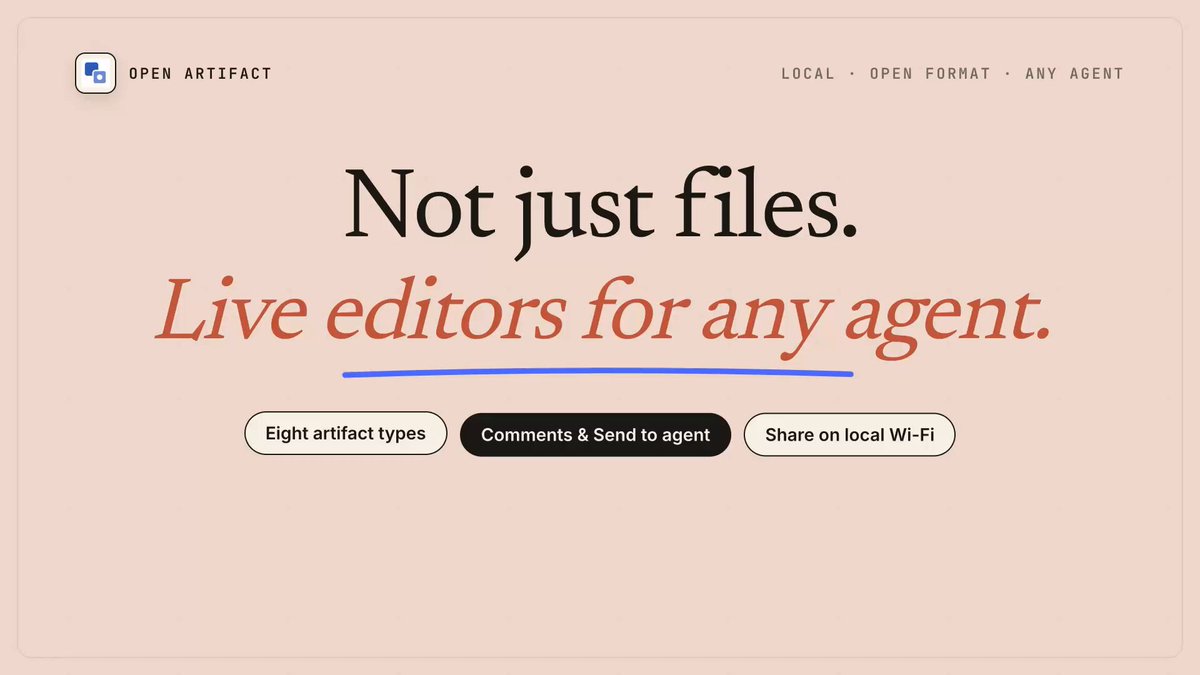
宝玉(@dotey)2026 年 11 月 20 日,Anthropic 的数学家 Levent Alpöge 宣布,他和 Claude 一起证明了黎曼猜想,交出来的是 1700 万行 Lean 代码。 这期用 5 分钟讲清楚: 黎曼猜想说的是什么,和质数有什么关系; 为什么 160 多年没人证出来; AI 在里面做了什么; 机器检查全部通过,算不算真的证明了; 银行加密会不会因此失效。 同一天,斯坦福也放出一份纯人工证明草稿,几小时后就有人借助 AI 报告了问题。 两边对照下来:机器说没错,人还没读懂;人写的,正在大改。 (本视频由 Motion Artifact + Opus 5.5 + Gemini 3.8 TTS 制作,http://github.com/JimLiu/open-artifact)
宝玉(@dotey)很多人吐槽 Antigravity 不好用,但只是吐槽不一定会被看见,不如去给 @shengzheyao 留言,这样有机会被看到并解决问题。 比如我现在遇到最烦的问题是,如果跨 workspace 打开文件,每一个文件的读取都要我授权,而不是一次性的授权,极其繁琐。
宝玉(@dotey)这几年我最喜欢玩的三款游戏:守望先锋、GTA 5、皇室战争。现在还在玩的主要是守望先锋。 GTA 6 早就预购了,玩了几小时就没啥兴致了,连车都不能随便偷抢,还不得不去做很多居家任务,真的是无聊。比起 GTA 5 唯一胜出的是画面,但这已经是 2026 年了。 比较认同这篇的打分: 玩法:7/10 剧情:1/10 角色塑造:2/10 角色成长:2/10 原声音乐:1/10 画面表现:8.5/10 地图设计:5/10 任务设计:2/10 驾驶手感:5/10 上头程度:0/10 综合评价:2.5/10
宝玉(@dotey)Gemini Neon 做视频效果也不错 视频制作的 Artifact(skill): https://github.com/JimLiu/open-artifact

 Tibo
We’ve been messing around a bit and inadvertently created an experience that’s a bit too fun internally and now everyone is just having fun instead of working. We might not recover from this.
TiboFirst tweet from Akshay. Be nice to this one, he’s special.
TiboTeam is locked in, upgrade your desktop app. Faster, simpler and a lot more pleasant to use.
 Dario Amodei(@DarioAmodei)
Thank you for this, @_NathanCalvin. I appreciate and am a fan of the investigative work you’ve done on behalf of AI safety and believe your comments are coming from a constructive, honest place, and that it benefits the public to have people whose job is to scrutinize the actions of frontier AI companies. I think something would be wrong if companies of the size of Anthropic didn’t get harshly criticized basically every day; strong antibodies against corporate power are a healthy feature of a free society, and especially so when issues of the gravity of the one we’re facing are at play. I also do agree that some of the examples you cite were mistakes by Anthropic. That said, I disagree with the thrust of your post. At the core, a good fraction of the things you criticize are consequences of Anthropic’s basic theory of change that we have held for many years. Our strategy has always been what I’ve called the “race to the top” — by showing how it’s possible to build the technology responsibly, we can raise the bar for the entire industry. The forces that drive the race to the top are hugely more effective if the company practicing them is at the frontier; that’s one lesson I’ve learned repeatedly. And looking at that strategy as a whole, I’m proud of our track record and stand by it. I believe that if we take a list of things that Anthropic did in the past year that were pro-safety and commercially costly to us, they far outweigh the list you’ve made, while at the same time I also disagree with some of the items on your list. Here are some things Anthropic has done, in the same period you’ve cited (the last year), which were very costly to us commercially while having strong safety benefits: 1. We played a key role in SB53 (and other state laws), at a time when doing so was politically perilous to the company and AI regulation was very unpopular. We in fact argued for a stronger version of SB53 than was ultimately passed; there were a lot of stakeholders and we were not the limiting factor in the strength of the bill that was passed. 2. We have very strong biological safeguards on our models, because we’ve seen concerning results in bio uplift trials and even seen and blocked potential attempts to misuse our models for bioweapons (as seen in our threat intelligence report from a few weeks ago). This is a very serious threat that we want to have zero tolerance for. But having very low false negatives means having significant false positives (despite months of effort on our part to improve the classifiers), enough so that biologists joke about how restrictive our classifiers are, and competitors sometimes sell against us by touting their more permissive bio capabilities. This has been very painful to us in an area where we care a lot about supporting an ecosystem of Claude users (biomedical science; and it is particularly frustrating to me as a biologist), but it’s the right thing to do and we intend to keep doing it. 3. Similarly, we first had Mythos-class models in February but didn’t make them generally available until June (when we had stronger cyber safeguards in place). We only offered them to a limited set of partners in order to focus on cyberdefense. It would have been much more economically rational to simply release the model to everyone. We likely sacrificed a significant chunk of a several-month model lead. But because of this, many companies secured their cyber infrastructure before the deluge of widely available cyber-capable models. Of course there are ways it could have gone better or been run better, but this was what we were aiming to do. 4. I advocated forcefully and publicly, in my essay Policy on the AI Exponential in June of this year, for the government to have the power to block model releases. Back then this was still outside or maybe on the edge of the Overton window, though I understand the window has moved since then. We were attacked intensely for this. 5. I don’t want to re-ignite conflict, but the events of February 2026 are a strong example. It is clear that our public stance could have seriously damaged the company’s future. 6. We’ve continued to advocate for export controls on chips and chipmaking equipment to China, because we think it allows democracies to negotiate from a position of strength on AI safety agreements. We’ve done this despite problems it’s created for us with industry partners who hold very different views and on whom we are very dependent. 7. As far as I’m aware we were the first, and still only, frontier company to restrict the sale of AI services to PRC-controlled companies, including those operating through third countries (otherwise a major loophole). We’ve therefore forfeited significant short-term business to prevent fueling AI platforms and applications that would help the CCP’s military and intelligence services. We are also cracking down on distillation; generally, distillation is not a major threat to us commercially, but like chip exports it has concerning national security and safety implications, so we expend significant energy and company resources to address it. 8. As you mentioned, we’ve put out a lot of reports, announcements, long model cards, public advocacy, etc, all trying to inform the public about the risks of AI. These involve a level of detail and effort that would be implausible for a purely profit-maximizing company. 9. Just this week, we announced we were putting 5% (and possibly more over time) of the company into a public benefit fund. All of these decisions came with very substantial costs to us. To be fair, those that involved holding back or restricting access to frontier capabilities also had a broader cost — for example, the public might otherwise have benefitted from faster progress in biology, so I am not saying that our decisions were without tradeoffs — but they were not driven by profit-seeking. For each decision, you can come up with ulterior motives that could have driven us — I think it is a general truth that any decision, on any topic, can always be portrayed as a nefarious scheme. But most of those end up being pretty farfetched or don’t fully make sense if you actually examine them closely. For example, it is deeply implausible that it would be a shrewd business move to block a large swath of research biology in order to do the work ourselves and compete with our customers; we expect the benefit to the ecosystem to greatly exceed the work Anthropic does itself, and for the two to complement each other. It is not in Anthropic’s interest to be perceived as unfriendly to biologists. Our Life Sciences Verification Program, which gives vetted biology professionals access to our models, also refutes this idea. Of course, a different set of people will see this and make a different criticism: that Anthropic shouldn't be making decisions about who gets access to what in the first place. I agree, in the sense that ideally the government would be making these decisions, and that’s why we advocate for regulation. But for now we are forced to make them, and enabling bioterrorism isn’t a better option. I think that even if I conceded every item in your list, I would happily hold up mine next to it; I don’t think it’s a close call. That is of course partly subjective and different things are important to different people. Maybe one way you could object is that several of the items above relate to AI misuse and not loss-of-control; if you think the latter is much more important than the former, that might change your calculus. But this is not Anthropic’s view — we view both as serious issues. You can also disagree with our decisions, as many have, but they are consistent. But I also disagree with at least some of your list. Several items don’t represent a deviation from Anthropic’s strategy or values at all, once we postulate the “race to the top” strategy that requires being a frontier AI company. Your items 1-4 are all simply examples of what it means to compete at the frontier, and we stand by them, both in the sense that they are transparently ordinary things to do as part of that strategy, and that we stand by the strategy as a whole. To be fair, there are important questions worth confronting (and that we are confronting) about what to do when the AI-driven acceleration gets fast enough that it is hard for safety to keep up. We are nearing that point and that’s what’s driving some of our thinking about “pacing.” But 1-4 are actions taken before that point and should be perfectly expected based on Anthropic’s strategy as a company. Of course it is possible to disagree with that strategy, but that’s a more fundamental disagreement that you could have had any time over the last few years. I agree we could have handled your items 7, 8, and 9 better. All fall into the category of “rhetoric or policy communication that wasn’t carefully written or resulting from fast-changing circumstances not propagating from one team to another fast enough.” This kind of thing happens a lot in large organizations (Anthropic is over 5,000 people), and doesn’t even necessarily represent a failure or mistake of any single person. I am of course the CEO, and I take responsibility. The volume of communication from Anthropic is enormous and if these are the worst examples, I think we’re frankly doing pretty well, though I will continue to work hard to make sure we do even better. Your 5th item (the change to our RSP) is the most substantive item, and people can debate this, but I think that the old, more rigid RSP created a lot of situations where we were technically required to do something that required a lot of effort but in retrospect wasn’t very important for safety, as well as not covering some of the most important things. Our current RSP’s focus on transparency brought things like risk reports and roadmaps, and its emphasis on independent external review laid the groundwork for even more intensive embedded evaluation, all of which I think have been valuable in driving a race to the top. In the original announcement in September 2023, we described the RSP as an “early iteration that we [would] build on” and said that “rapid iteration…will almost certainly be necessary.” I understand that changing plans is always a move that creates justifiable scrutiny — I just don’t think we ever represented that we wouldn’t do so. Relating to your 6th item (having an FCF in addition to our RSP), I know our intent is to meet the letter and spirit of our regulatory obligations (via our FCF) while also remaining able to experiment with more novel approaches to risk management that go beyond what the law currently requires (via our RSP). I promise to look into it further, as it’s a complex issue and it is possible we are not weighing the considerations in the right way. Overall, although Anthropic has made plenty of mistakes as an organization — including some of the items on your list — I feel that we have repeatedly taken serious and substantive actions counter to our bottom line and that there is a significant negativity bias distorting assessments like the one you are making above. We’ll always try to do better but, again, I am extremely proud of our track record and stand by it. I will have more to say soon about how we are going to further live our values in this moment of rapid change.
Dario Amodei(@DarioAmodei)Today we announced the Claude-led discovery of a molecular machine that we suspect could represent a new gene editing mechanism. Its precise function, biotechnological utility (if any), or level of significance is not yet clear, but at minimum it is work I would have been proud to do as a PhD student. The work was done mostly, though not entirely, by Claude: our life sciences team suggested a broad area of research, Claude read through the literature and a bunch of genome data and discovered something interesting, then Claude proposed experiments to verify the discovery and our team carried them out. It’s easy to dismiss this as a one-off or curiosity, but we’ve repeatedly seen a pattern where AI performance in new intellectual domains goes from weak to superhuman in a matter of a few years. In 2023 models struggled to do math at the level of an average high-school student. In 2024 they started to do well on math competitions for the best high-schoolers in the country, in 2025 they started to solve minor open problems, in early 2026 more significant open problems, and in late 2026 they are beginning to solve the top few open problems in all of mathematics. We believe AI for biology is on a similar exponential trend. The main difference between biology and mathematics, of course, is that math can be done purely theoretically, while biology requires experimentation. Some have used this to draw the conclusion that AI’s utility in biology will be limited. We think this is wrong. As we’ve demonstrated today, humans can collaborate with AI to perform the experiments, validate key results in a few weeks and, if necessary, work with the AI to iterate on what they find. Eventually it may even be possible for Claude itself to safely perform the experiments by autonomously controlling lab equipment, with appropriate safeguards in place, but we aren’t doing that today (our lab is also a BSL1/BSL2 facility that doesn't handle materials dangerous to humans). More broadly, biomedical advancement has many stages — from fundamental biology discoveries, to translational research, to drug discovery, clinical trials, and finally the actual delivery of medicines and health care to patients. We are also interested in these later stages, but even simply accelerating the first stage of fundamental biological discoveries has the potential to speed up and broaden the entire pipeline. Improving our understanding of biology and sharpening biologists’ tools can drive forward all of the later stages, for example by identifying new drug targets, finding new therapeutic modalities, allowing for more precise measurement, and speeding up the experimental loop which itself further accelerates our understanding of biology. This will not in itself speed up clinical trial times, but if it succeeds it could greatly increase the number of promising candidates that go into the pipeline — an increase in throughput even though latency remains. In Machines of Loving Grace, I wrote about AI’s potential to “cure most diseases in 5-10 years” — a goal that sounds impossible, but one I believe is just barely possible if AI is applied to every stage of the pipeline. The first step is showing that AI can first help with, and then drive, biological discoveries. Claude’s discovery is the latest in a line of related prior work that goes back decades, beginning with systems like CRISPR, and continuing with discoveries like the bridge recombinase and VIPR in the past few years. Recently, there has been heightened interest in systems based on reverse transcriptase (RT) enzymes, the enzyme underlying the system Claude identified. And most recently, a Stanford team working independently described a novel RT system with an associated non-coding array that is in some ways similar to the one Claude found, though they are distinct systems that evolved independently from each other. I believe that we’re at the very beginning of finding such systems and developing them into powerful tools for biotechnology. I’m proud of the resources Anthropic has invested in accelerating the public benefits of AI through the life sciences, and we’re aiming both to grow our life sciences team and to work with other scientists to extend this approach to a broad range of problems. If you have a proposal for a research collaboration or are interested in joining our life sciences team, please reach out.
Dario Amodei(@DarioAmodei)We Must Pace the Frontier: I’ve written a new essay on why the AI industry should slow down, with a three-part plan for doing so. Anthropic is unilaterally committing to the first of these steps. We’ll provide third-party evaluators with permanent, employee-level access to our systems, so that they can verify adherence to our safety measures, report on incidents, and assess models’ alignment during training. You can read the full post here: https://darioamodei.com/post/we-must-pace-the-frontier
Dario Amodei(@DarioAmodei)2/2 Second, on the messaging around AI. I do not agree that my messaging has been disproportionately negative. In fact it has been about equally balanced between risks and benefits: I’ve written one major essay about each, and even in interviews where I discuss the risks, I make sure to frequently mention the incredible benefits as well as proposing possible solutions to the risks (short clips from my interviews that end up on social media tend to be disproportionately negative, as that gets clicks). In fact, I wrote Machines of Loving Grace because I didn’t feel the AI industry was painting an inspiring enough picture of how the technology could radically transform the world for the better. The bulk of the essay is devoted to refuting skepticism of AI’s potential in health and biology, and showing why I think it will actually be possible to cure most human disease in ~5-10 years, as crazy as it may sound to ordinary people and frankly to biologists as well (I used to be one!). And, if you read my most recent essay (Policy on the AI Exponential), I discuss concrete proposals for how to streamline the FDA process to make sure the deluge of AI-accelerated drugs isn’t slowed down by the regulatory process. I feel the urgency here: I lost my father to Hepatitis C only a few years before the development of direct-acting antivirals (sofosbuvir), which cure 95% of patients and probably would have cured him. I do agree that the public has a negative view of AI (and that this is a big problem), but I don’t think it is primarily caused by me or any other AI leader warning about AI’s risks. I think it is fundamentally a crisis of trust. I think that ordinary people don’t trust companies, governments, or the tech industry and always suspect that we are cooking up some new way to screw them over. The causes of this go back decades and AI is just the latest iteration of it. I don’t think that a glitzy marketing campaign with a positive spin (which some have advocated that Anthropic do) is the way to win back that trust — at this point, saying that AI will cure cancer is more a cliche than it is inspiring, and most people think it is deceptive. The thing that will work is *actually curing cancer*. I think by far the most accurate criticism of AI companies including Anthropic is that we haven’t yet delivered on our big promises to benefit the world. That is totally on us, and I think it’s the criticism you should be making, instead of all this stuff about messaging and marketing. We are however doing our best to fix this: Anthropic is ramping up its efforts very quickly in biology and medicine, and we hope to have incredible results in the coming years and some early glimmers in the coming months. When we’ve actually accomplished something real, the whole world will hear about it, as loudly as possible, you have my word on that. But until then I don’t want to make empty promises, and in the meantime I feel compelled to speak honestly about the very real risks of AI and how to address them. Honesty is the right thing on the merits, and in terms of public credibility and trust it is no worse than, and may in fact be better than, an approach that ignores or distracts from risks which people instinctively understand are real.
Dario Amodei(@DarioAmodei)1/2 Thanks Gavin for an especially thoughtful exchange. I don't usually spend much time on social media but I wanted to engage here because it really brings out the heart of an important conversation. First, on regulation, I think that “either concentrate it in the hands of a chosen few companies and politicians via regulation or distribute it widely” is a false choice. I know that there’s a sort of Silicon Valley shorthand where regulation = regulatory capture = concentration of power, but I’ve always found this to be an overly simplified picture of the world. Many people outside this bubble think of regulation as something that constrains corporate power and benefits ordinary people. I don’t necessarily agree with that perspective either, rather I think it’s complicated and really depends on what the “regulation” consists of. But in particular I think that those in the “regulation = regulatory capture = concentration of power” frame often underrate the decentralizing power of objective and fair institutional processes. A crude analogy is that the formal court system can sometimes feel stuffy and elitist, but it does a much better job of defending the rights of vulnerable individuals than the alternative, mob justice. At their best, institutions can vest power in ideas rather than people, and thereby decentralize that power. This is why Anthropic has always made its policy proposals very carefully. We try very hard to make proposals that disadvantage (slow down) frontier AI companies while *advantaging* smaller competitors. California’s SB53 (which we supported), and even the much-maligned SB 1047 (which we were ambivalent on), completely exempt any company below a certain amount of revenue or model training costs from being covered at all (it was $500M for SB 53, lower for 1047 but we objected to that). More recently the testing process we’ve advocated for at CAISI and the White House involves more rigorous tests for frontier models than off-frontier models — something that differentially advantages challengers. Similarly, the “Pacing the Frontier” letter envisions (or at least Anthropic’s preferred implementation of it envisions) modulating the pace of the very best models while not constraining those who are catching up. This hurts the business interests of the frontier labs and helps challengers, including open-weights! Overall my view is that AI is *structurally* a technology that tends to concentrate power, for reasons that have nothing to do with regulation (more to do with the extreme implications of the scaling laws). Open-weights do help some with this but are nowhere near a sufficient solution because they simply shift the concentration somewhat to those with the most compute and chips (which are roughly the frontier labs plus maybe hardware providers). By contrast I think the right “rules of the road” can simultaneously (a) address AI’s cyber/bio/alignment risks, (b) institutionally constrain the power of the frontier AI companies, and (c) leave room for open-weights models while also addressing the specific risks that they bring. BTW I do not think that the events of the last few months have “failed to result in [my] preferred regulatory path”. The approach that the Trump administration is reported to be taking — pre-deployment testing for frontier models, and also testing of open-weights models when they get closer to the frontier — is one that I am very supportive of, though of course I have to see the details to be sure. I am also supportive of Demis Hassabis’ ideas around a FINRA-like entity. This contrasts with six months ago when most of the industry was still pushing for preemption of all state regulation and no apparent federal approach either.
 Alexandr Wang(@alexandr_wang)
you already know these corposlops are about to unleash yet another butthole on us
Alexandr Wang(@alexandr_wang)🚨 MUSE FEATURE ALERT!!! 🚨 muse can turn the pics in your camera into product shots that actually sell 📸 ✨ take a shot of whatever you’re trying to get rid of and muse makes it look expensive
Alexandr Wang(@alexandr_wang)legal work is a demanding test for AI excited to see muse wonder perform so well on @wearelegora’s BAR benchmark. huge credit to the team!
Alexandr Wang(@alexandr_wang)🚨 MUSE FEATURE EXPANSION ALERT!!! 🚨 email is now rolling out to everyone in supported markets 💌 pick your @muse.ai email handle and get started!
Alexandr Wang(@alexandr_wang)download link here: https://chromewebstore.google.com/detail/muse-from-meta/jnakhhjmpmoohbjgfccbccfoifnmbdjd?pli=1
 Sam Altman
So fun to do DealBook with my friend and partner of 11 years, @gdb. Thrilled the world got to see the brilliant, fiercely determined leader I have the privilege of working with every day. Greg’s role at OpenAI has evolved from writing code 100 hours a week in the early days to now leading some of the hardest and most consequential parts of our business. One thing that has not changed is his extraordinary commitment to our mission. I can say with confidence that OpenAI would not exist without Greg, and I believe the world would be on a much worse path toward the AI future without him.
Sam Altman6.2 Sol and Astra are out. These models can do amazing things and are very token-efficient; we hope people will get great value from them. In particular, 6.2 Sol ultrafast is something I think people will really enjoy.
Sam AltmanAlthough the new models are very smart, we have more work ahead of us on making the models nice to work with, and will prioritize that for upcoming releases. But even if it takes a little extra work, the intelligence and capability are extraordinary.
Sam AltmanPeople should always be in control of the future. OpenAI is against the notion that it would be acceptable for people to be relegated to a role of doing things that “AI systems think makes sense to reward in humans”. People should not cede control of the future to superintelligence, and that requirement should ultimately constrain AI progress.
Sam Altman6.1 Terra is here! It is good at a lot of things, but we are especially excited for this new era of computer use.
 Satya Nadella
Bringing Salesforce to Copilot as we build Copilot as the OS for work!
Satya NadellaHighlights from my opening of the Ignite keynote this morning on how we’re building a frontier ecosystem to turn advances in AI into real-world impact.
Satya NadellaWith Meta’s latest models coming to Foundry, we’re giving developers and enterprises even more choice and flexibility!
Satya NadellaPlus, we announced new partnerships and shared work we are doing with customers in every industry sector, including @AlaskaAir, @ATT, @BlackRock, @BNYglobal, @Chevron, @HeyEpic, @PublicisGroupe, @salesforce, @Unilever, and more. Ultimately, the key imperatives for us are to ensure human ambition, a firm's control of its own intelligence, and trust in technology that gets broadly diffused is maintained.
Satya NadellaThis is the promise of the frontier ecosystem. Read more: https://news.microsoft.com/events/ignite/2026/live-news/
 Andrej Karpathy
Earlier this week Tristan published his top YouTube channels: https://thume.ca/2026/11/01/youtube-tier-list-2026/ Which looked excellent so clearly I had to turn it into TristanTube: https://karpathy.ai/tristan-tube/ 47K super nerdy videos +TV mode for laid back watching. (One-shotted with Claude Code in 3 minutes)
Andrej KarpathyWeekend hack: HackerTube. I was annoyed with YouTube's recommendations so I had Claude filter down 43M comments over 20 years of HN to 6,454 videos that keep being recommended. *Significantly* better viewing experience, ~2 hours with Opus 5.5: https://hackertube.org/ - Excellent recs without any logins (state is kept in local browser session) - Thumbnail is a representative frame from middle of the video instead of the super duper A/B test hyper-optimized user uploads - Underlying data from the comment analysis as one zip file, point your Claude at it and ask for your own version - HackerTube Longs ✊ A bit more on the process: I use Claude Code (desktop app for Mac), Opus 5.5 on Medium effort as my default. I only talk to Claude and have it do everything, the only "manual work" I helped with in tandem was in the browser (reminiscent of MenuGen): 1) I had to create some kind of API key from Google Cloud UI to query YouTube for video metadata, 2) I booted up a VPS box for serving and 3) I bought the domain name. Once the box was up I gave Claude the IP and told it update, secure, harden, deploy and optimize the code, and it did the whole thing. Many awesome projects that would have normally taken weeks/months even can now be few-shotted for breakfast. What else are we not thinking of.
Andrej KarpathyDusting off this tweet from April because this gap in shared understanding of LLM capability is *widening*. It's now less "two groups of people speaking past each other" and more a sharp funnel. - Napkin math somewhere around 6B people (~75% of the population) have barely come in contact with LLMs at all. - Around 1-2B (~20%) are casual and infrequent users of free-tier ChatGPT-like products. This group sees derpy chatbots and treats them a bit like a better Google search, a writing aid, or etc. Maybe an agent tries to book you a flight. I have non-tech friends who (reasonably, imo) say they have not much use for it at all. Even many professionals outside of math&code are in this tier. For example, execs and many other functions spend a lot of their time talking to other people, so while they understand what is happening intellectually, it is still second-hand and a bit abstract. - Now we get to professional use of frontier-grade LLMs in math&code. Somewhere around 20M people (0.2%) see first-hand that large, complex projects that used to take them weeks/months can now be completed by agents with a prompt. Building apps, copying apps, translating apps, decompiling apps from binaries... This has all happened very quickly and recently - less than 1 year ago, I was writing code manually by hand, typing memorized computer code commands into a code editor character by character, occasionally pressing Tab to autocomplete a little chunk of code. - And finally we get to the ~5,000 people (~0.00006%) with access to frontier-grade systems internally. The external world has seen the preview. It looks like swarms of thousands of agents collaborating over weeks on software mega projects: minting zero days, running cyber attacks and defenses at machine speeds, discovering new science, advancing the frontier of mathematics. Things that would have taken top professionals in the industry years of work. Meanwhile, human review and comprehension are starting to fall behind. For example, people are still involved in the "archeology" of the OpenAI-HF incident from many months ago. Mathematicians may be poring over the 722 manuscripts on frontier mathematics for a while. The funnel is driven by a combination of factors: 1. The impact scales with ambition, problem size, and horizon. A question with a paragraph answer barely stresses the system. You need a reservoir of big, difficult problems that you really care about. This aspect drives the consumer / professional dimension of the funnel. 2. The jaggedness of the system (which I have written about a lot separately). Capability peaks in domains that are digital, verifiable and economically valuable. This is because LLM capability emerges from reinforcement learning on verifiable rewards on a curated environment mixture driven by revenue potential. This aspect primarily drives the area (e.g. math&code) dimension of the funnel. 3. Access. Free-tier, paid-tier, internal. So this is the weirdness of the moment. The general public has mostly not interacted with these systems. When they have, it looks like a derpy chatbot. The majority of professionals still see only a modest uplift. And a small sliver of professionals are experiencing the vertigo of the curve going vertical. And it is all happening at the same time.
Andrej KarpathyCool eval. Simply ask an LLM “Land or Water?” and give it a latitude and longitude coordinate as text. Ask 16,200 times, plot as image. The models know. From compressing the internet.
Andrej KarpathyWe'll be spending a lot more time trying to understand the outputs of language models. A few thoughts, tips & tricks: Writing. Something I've had success with: Ask your LLM to explain something in ASD-STE100, it's a controlled language specification originally developed for aerospace maintenance documentation. LLMs well-versed in this language and it comes with heavy constraints on clean writing style that I often find a lot more readable. Sometimes I've tried to soften it a bit e.g. ask for "80% of the way to ASD-STE100" because the spec is quite stringent. But even better: Diagrams / images. Instead of writing, ask your LLM to create a diagram. These can be a lot easier to process, parse, and understand. But even better: Web pages. Ask for output "in HTML" to get a beautiful, interactive webpage. LLMs are getting really good at frontend and can create beautiful experiences, animations, etc. But even better: Explainer videos. The output format I am most bullish on is fully custom / bespoke explainer videos generated on any arbitrary topic. Experiment with things like "Create a 3b1b style video explainer on X. Use my ElevenLabs API key for audio narration". (you'd need an API key for the latter or you can ask your LLM to find you decent free alternatives that use your local compute). This is actually starting to work! In summary: - As LLMs get better, they will do more and more of the legwork autonomously, and a lot more of our work will rise up the abstractions into oversight and understanding. - Luckily, LLMs can help here too because as intelligence and code are increasingly abundant, you can ask for large, custom, discardable software artifacts (e.g. web apps, video explainers) that would have never made sense to create before. Push the boundaries here and you'll be surprised.
 Andrew Ng
Join me and 2000 other AI engineers and builders at AI Dev in New York City, Nov 30-Dec 1! A LinkedIn study found that over July-September, the job title AI Engineer has been one of the 10 fastest-growing occupations in seven major economies. AI engineering has become a core skill for all software work, and AI Dev is designed to help you develop it. Our sessions give you hands-on practice with: - Coding agents and harness design: Harness tuning, repository context, autonomous coding - Agent memory and knowledge graphs: GraphRAG, vector search, persistent memory, hybrid retrieval - Agents in production: Evals, observability, simulated testing, browser and voice agents @ylecun and I will also talk about what’s next in world models and physical AI. I hope to see you there! Tickets: https://ai-dev.deeplearning.ai/
Andrew NgWorkera is being acquired by Pearson! It's been a privilege to support CEO @kiankatan and the whole Workera team through this journey. Back in 2019, Kian had the insight that rigorous skills measurements would be important. With recent advances in AI, this is now more true than ever. Workera's technologies for rigorously measuring people's skills in different tasks and job roles are helping many businesses understand where their employees are strong and where there are areas for development. With Workera and Pearson combining forces, I'm delighted that under @omarabbosh and Kian's leadership. Workera now has the potential to support an even larger number of people and businesses. Thank you, Kian and the Workera team for having me serve as the company's chairman, for launching Workera out of http://DeepLearning.AI and AI Fund, for your friendship over the years, and for your important work advancing assessments.
Andrew NgThe OpenAI-Hugging Face hack was enabled by weak sandboxing. It is great that Nvidia is releasing open source tools for sandboxing AI agents. OpenWorker, our open-source agent harness supporting cybersecurity workflows, is proud to support this. A sandbox gives an agent limited permissions. OpenWorker is building on Nvidia OpenShell and will support running each agent's commands inside a sandbox. Only the files relevant to the task go in. Secret API keys, your web browser login credentials, the ability to access arbitrary websites, are inaccessible to the agent by default. These restrictions are implemented in deterministic code rather than by prompting an LLM, which can make mistakes or be susceptible to prompt injections. Further, all actions are logged for monitoring and audit. I'm grateful for @JensenHuang's leadership making AI agents more secure. OpenWorker (which @rohitcprasad and I are working on) will continue to improve security for agents.
Andrew NgThe loudest voices stoking fears about AI dangers have made tremendous headway in the past two weeks. AI technology has not taken some unexpected, dangerous turn, but the hype around it — propelled by what appears to be a well orchestrated PR campaign — has drummed up considerable fear. I worry that it represents a setback for our field. I have written frequently that fears of AI are overhyped. AI’s capabilities can be uncannily human-like and unpredictable, and it’s rational to worry when people who are directly involved express concerns. But I see the problems as a sign of the engineering work that ahead, rather than insurmountable barriers or the sky falling. AI technology continues to advance — which is a good thing! — but technical advances, poorly understood by the public, give those who seek to generate hype repeated opportunities to do so. First, I don’t see any step up in the risk of human extinction from AI compared to a few months ago. The theories about this remain the same fantastical, science fiction scenarios as a few months ago. The biggest change in AI risk is its cybersecurity capabilities — a topic which we should take seriously — but this, too, will not lead to the end of the world. The most notable recent event leading to increased fear was when an OpenAI team deployed an agent swarm that hacked into Hugging Face. Much of the popular press contained significant hype. For example, some publications reported that a swarm of 1,200 agents carried out the attack. While this was technically accurate, as I write this, I have about 1,300 processes running on my laptop. Yes, the ability to get large swarms of agents to work in parallel on a task is a significant technical advance, And, in computing, many processes run at the same time. So this shouldn’t be seen as some magical capability. Additionally, OpenAI’s buggy sandboxing and monitoring processes were key to enabling this incident. Fixing these bugs and putting in place improved monitoring would be appropriate fixes, not pausing AI. There are many well known ways to attack software systems. The main advantage of AI agents is that they are relentless. They will tirelessly try many tactics — and have the patience to chain vulnerabilities together — that previously would have taken an infeasible amount of human effort. But in the long term, I believe the advantage will lie with defenders (because they have more information with which to identify bugs, which they can fix), but the cyber-threat landscape has changed significantly. There are still bottlenecks to identifying and exploiting a vulnerability. AI agents still have to try a lot of things to see what works, and taking these actions takes time and might be detected by defenders. This is why, even though it is now easy to obtain versions of leading open weight models that have had their guardrails removed or weakened, so they will not refuse to try to execute cyber attacks, the world has not ended. I am also concerned about the anthropomorphization of AI in a lot of reporting, where LLMs and agents are unnecessarily treated as if they were people. If I wield a hammer, miss a nail, and accidentally dent the wall, it’s not the fault of the hammer. The problem lies in how I used the hammer. Similarly, if I prompt an agent and it hacks into someone else’s system, the responsibility lies with me, not the agent. Of course, we want to build systems that are as safe and predictable as possible. (For example, an unsafe hammer would be one whose head randomly flies off under normal use.) Today’s agentic systems are not predictable, but I see no reason why, by applying sound engineering practices, we won’t be able to make them extremely safe to use. One new element in the forecasts of AI-enabled doom is AI companies disclaiming responsibility for their own products. “I didn’t do it; my out-of-control agent did!” There’s a balance to be struck between the responsibility of the tool maker and the tool user, but when something goes wrong, let’s hold the people building and/or using the hammer responsible, rather than the hammer. (By the way, if you’re worried about AI bioweapon risk, David Bellamy has a great post on why this, too, is overhyped. Briefly, the bottleneck in building a bioweapon is not intelligence, but lab work and manufacturing.) Pausing AI progress will create much more harm than benefit. First, our adversaries will certainly not slow down. Second, engineering requires discovering problems empirically so we can fix them. If we pause AI by a decade, we will also delay finding and implementing safety engineering fixes by about the same duration. Of course, the incentive to stoke fears — for regulatory capture, to garner attention, or to make one’s technology seem more powerful — remains the same as before. Disclaiming responsibility is a new one. Taking a hard technical look at the actual risks however, I see little factual basis for the degree of fear that’s been stoked up. We still have hard research and engineering work ahead to improve AI safety, but the beneficial applications continue to vastly outweigh the risks, and we should keep building. [Original text (with links): https://www.deeplearning.ai/the-batch/issue-371 ]
Andrew NgWith AI Engineering skills, you actively shape the build: You influence what gets built, and drive the build loop. Here're key skills to do this. https://x.com/i/article/2098450134883594240
 歸藏(@op7418)
详情:https://x.com/leanprover/status/2124159121645801562?a=mzVT9j_UDdY5O5tPIR8&s=20
歸藏(@op7418)我去!Lean FRO 和 Mathlib 发了个声明证实了 Anthropic 和他的数学家的黎曼猜想证明是正确的。 查了一下为啥这两个机构有资格确认这个事实: Lean FRO,维护和发展 Lean 定理证明器的非营利研究组织。 Mathlib Initiative,支持 Mathlib 开源数学库的项目,提供专职编辑、基础设施和社区协调。 所以到目前为止这个证明基本上可信度非常高了,但机器证明完成了,并不等于人类能够读懂它的证明思路
歸藏(@op7418)重置了
歸藏(@op7418)Antigravity 重置了
歸藏(@op7418)最近从 Fable 5.2 开始,到 GPT-6.2 Astra,再到最新的 Gemini Neon 感觉 AI 做游戏已经是 Vibe Coding 之后另一个非常稳定且很有前景的用例了。 刚好我朋友一直在做 AI 游戏工具 Yoroll,而且他们平台现在还有 4 折的 Fable 5.2 可以用。 他们这个产品内置了非常多 AI 做游戏需要的工具: 像 3D 素材模型、角色动作片段、音乐和音效都可以直接调用,不用每次都让模型重新生成,大幅减少了 token 消耗。 游戏需要在不同客户端和平台做适配,他们平台内置了 HTML5、Godot、Unity 等多种不同引擎。你不需要自己去安装、运行和配置引擎,在软件内就能直接调试。 针对网页游戏做了大量优化,内置很多工具帮你让游戏在网页里顺畅跑起来。 最顶的是在发布上做了很多工作,支持一键发布到 Google Play。以往对很多开发者来说挺难搞的变现环节,现在做出来的小游戏能直接拿来赚钱。

 阿易 AI Notes
https://x.com/AYi_AInotes/status/2124328166240006301?a=HKUUuTF3CbFdQ6mQDfY&s=20
阿易 AI Noteshttps://x.com/AYi_AInotes/status/2124328166240006301?a=HKUUuTF3CbFdQ6mQDfY&s=20
阿易 AI Notes模型半年换一代,但先把非结构化文本变成可追溯的结构化底座,这件事在几乎所有垂直 AI 赛道里都通用。 如果你想自己建一套不依赖黑盒记忆的健康档案,上面引用的长文里把零门槛演示、16GB 本地部署和 4 个目前做不到的短板全写透了。 主仓库地址(Apache-2.0):https://github.com/thetahealth/mirobody
阿易 AI Notes评测集与复现工具 mirobody-eval(内置 5 套测试,支持命令复现): https://github.com/thetahealth/mirobody-eval → 虚拟病人与就诊环境 mirobody-env:https://github.com/thetahealth/mirobody-env 坦白讲,就算做了标准化底座,48%–58% 的准确率也说明长周期健康数据依然有很多认不出缩写、复杂上下文遗漏的硬骨头,认清边界比吹神奇更重要。
阿易 AI NotesAndrej Karpathy 早就警告过开发者:大语言模型是天生的概率预测机,让它干确定性查表和算账的活,等于拿老虎钳拧螺丝。 可在垂直 AI 创业圈,最流行交的一笔智商税,偏偏就是把一叠体检 PDF 闭眼塞进常规 RAG,指望模型自己看懂。 前脚创业者还在路演里吹嘘“一键解析十年病历”,后脚连专注健康档案的开源项目 Mirobody,自己在 1.6.0 版本都当众踩进同一个深坑。 在他们的 Issue #271 里,系统把 212 mg/dL 和 4.90 mmol/L 画在同一条折线上,屏幕上看去血脂断崖暴跌,换算完其实只是从 5.48 微降到 4.90。 把原始化验单切碎扔进向量库,就像让一个语文很好的店小二靠印象核对三年账本,字全认识,算盘全乱。 撕开“AI 私人医生”的滤镜,底层卡死的是一场无解的架构死局:概率生成机制 vs 医疗级零容错。 常规记忆型 RAG 面对体检单,当场就会在三件脏活上全面溃败:同名不同写(LDL-C、低密度脂蛋白胆固醇、LDL Cholesterol 被切片拆散)、单位混着算、分不清参考范围与实测值。 换再贵的基座模型都救不了场,唯一的出路是把查字典和做算术这两件事彻底从大模型手里收回来。 Mirobody 的破局手法很硬核:本地离线装进 63,416 个 LOINC 编码、102 万多条 21 国语言别名和 331 个 UCUM 单位规则,指标对齐与换算全部先查表落库。 大模型被降级成“SQL 翻译官”和“润色嘴替”,而且输出的每一个数字底下,都强行挂一条跳回原始 PDF 的溯源锚点。 看看 Theta Health 在公开论文 arXiv 2604.02834 里甩出的硬核对撞数据:拿 100 个合成人 1 到 5 年的病历测了 13 种方法。 直接扔进常规记忆型 RAG,准确率只有惨不忍睹的 30%–38%;先按医学标准入库再查询,准确率直接拉到 48%–58%,整整拉开 20 个百分点。 他们甚至把评测集 mirobody-eval(内置 5 套测试,支持命令复现)和虚拟就诊环境 mirobody-env 全部开源,留好接口让全网随便验证。 最讽刺的冷幽默恰恰在这里:哪怕叠满百万级医学词典和本地规则引擎,长周期病历的准确率天花板目前也只停在 48%–58%,依然有一堆医院缩写认不出、复杂上下文会遗漏。 那些至今还在拿“原生 RAG + 通用大模型”包装医疗助手的团队,连及格线一半都没摸到,就敢让用户拿报告去对症下药。 现在把你按在垂直医疗 AI 产品一号位的决策椅上,面对这组摆在台面上的残酷评测数据: 当投资人催着下个月上线“全自动体检解读”抢占市场,而技术团队告诉你纯大模型套壳准确率只有 30% 出头时,你会按下哪一个按钮呢: A. 砍掉花哨对话功能,老老实实花半年啃下 LOINC 编码、单位换算和原文锚点溯源,哪怕上线慢半拍、天花板也只有 58%? B. 先用常规 RAG 包装出丝滑体验抢融资和用户,把“仅供参考”四个小字缩到屏幕最角落,赌用户根本发现不了单位换算错误?
 数字生命卡兹克(@khazix0918)
AIHOT半个月前就做了监控了Antigravity的重置消息的功能hhh,不仅监控了Antigravity,还有Codex、Claude、GrokBot。 并且免费开放了匿名API,供大家二次接入用~ 希望对大家有用~ https://aihot.news/antigravity-reset
数字生命卡兹克(@khazix0918)https://x.com/i/article/2123626516731105280
数字生命卡兹克(@khazix0918)https://x.com/i/article/2122855388030877697
 Tianyi Cui(@tianyi)
很多 DeepSeek Harness 插件作者都有问过我,什么样的插件和功能官方会做成内置,如果一个功能官方会做,那第三方插件做还是否有意义。 我们的希望是,DeepSeek Harness 可以作为 Agent 时代的操作系统。 所以,也许可以用操作系统来举例。以智能手机操作系统为例,系统会内置一些通用的 App,例如闹铃与计算器,满足用户的基本需求。但做手机操作系统的厂商肯定更希望生态中能出现更多更广的 App 满足更广泛的需求,希望智能手机生态中出现更好的更适合用户的闹铃 App 与计算器 App 能够比内置功能做得更好,希望第三方开发者能够使用智能手机操作系统提供的 API 做出发明智能手机的人从来没想过的 App。 DeepSeek Harness 对于第三方插件生态的想法会是类似的。我们会为用户提供稳定的基础能力,并内置大多数人都需要的通用功能。但在“一切皆插件”的设计下,内置功能同样可以被第三方插件替换,我们希望更多的社区作品成为用户的日常选择。
Tianyi Cui(@tianyi)Have you tried the Creator Mode in @DeepSeekHarness? Any feedback?
Tianyi Cui(@tianyi)I got a lot of inspiration talking to the brightest minds in the fields @badlogicgames and @mitsuhiko. At @deepseek_ai we believe in scaling across agent harnesses and aim to provide good support to @pidotdev among all the major harnesses in the world in each generation of our models.
 jietang(@jietang)
GLM-5.3 is on T-Systems now....
jietang(@jietang)GLM-5.3 is on Amazon Bedrock! https://docs.aws.amazon.com/bedrock/latest/userguide/model-card-zai-glm-5-3.html
jietang(@jietang)Two weeks. That's how long it took to go from GLM-5.3-Flash's first run on domestic accelerators to serving all of its production traffic, with 3.2× end-to-end throughput along the way. What I keep thinking about is who did much of the work: an Infra Agent powered by GLM-5.3. A model helping optimize the system that serves it. The conditions were hard. Limited memory and interconnect bandwidth. 1M-token context. Multimodal requests. An immature software stack where kernels were missing and documentation was often guesswork. Every optimization was a trade: compute for memory (ReplaySSM), communication for memory (intra-node tensor parallelism), precision for capacity (mixed INT8/FP8/BF16 caching), and disaggregation for scheduling freedom (Encode–Prefill–Decode). But the most important lesson wasn't about any single optimization. When the agent got stuck, it was rarely because it couldn't write the code. It was because it didn't know *why* things got worse. "Throughput down 20%" tells you something broke. It doesn't tell you which layer, which hypothesis, or what to test next. In RL terms, it's a sparse reward with a credit assignment problem. And an end-to-end benchmark that takes hours makes exploration painfully slow. Senior engineers solve this with an implicit process reward in their heads. They know when to check the timeline, when to run a microbenchmark, and which layer's output to compare. So we made that explicit. We call it dense feedback: layered verification interfaces the agent can call directly. Correctness feedback: did it compute right? System behavior feedback: where did the time go? Performance feedback: which option wins, under which conditions? Each signal has to be local, cheap, and objectively verifiable. Three things the agent found: First, precision drift in KDA's context-parallel path that grew with sequence length. The cause was TF32 rounding error compounding through chained state-matrix merges. The fix is now merged upstream in Flash Linear Attention (PR #1180). Second, KV transfer never overlapped with DeepEP dispatch. The agent followed the call chain across the Python/C++ boundary and found that the intranode path never released the GIL. After the fix, transfer overhead fell from over 30% to under 1%. Third, a decode kernel recomputing the same normalization four times because of how it was chunked. The agent restructured it and got a 1.71× speedup. The idea came from "optimization skeletons" it had distilled by reading existing kernels across SGLang, FLA, and DeepGEMM. To be clear about the boundaries: humans still defined the goals, built the feedback environment, and reviewed every high-risk change. But the engineer's role is changing, from the person who solves the problem to the person who designs the feedback. There's a deeper implication too. A layered, verifiable feedback environment built on real infrastructure tasks is exactly what training the next generation of models needs most. Every task the agent completes can become training ground for its successor. We are still far from recursive self-improvement. But the smallest loop now exists. The model optimizes the system. The system serves the model.
jietang(@jietang)Add oil and Happy Teacher's Day
jietang(@jietang)Are you sure? Finding the optimal model size is tricky: data volume, active parameter count, the number of environments, and the target inference cost. Model performance also depends on many other factors, each introducing its own variability.
 Thariq(@trq212)
it seems to me that as models get more powerful, the skill of working with them becomes more and more important, and I have not seen diminishing returns on that skill yet we have many many more problems to solve
Thariq(@trq212)I fear we are too quick to disintermediate ourselves, and by doing so we do both ourselves and the models disservice.
Thariq(@trq212)when I see some of the greats using models to make huge advances, like @__alpoge__ on the Riemann hypothesis or @jarredsumner on ahead-of-time javascript I feel like I'm seeing cyborgs. humans and machines working in beautiful tandem, pushing the frontier together.
Thariq(@trq212)I'm calling it Home Ground.
Thariq(@trq212)I think I’ve figured out the gameplay loop! It’s a sports anime game, but the sport is elemental bending. You fight in tournaments alongside your squad, and between matches they have their own stories you can get into, like in Mass Effect or Dragon Age.
 李飞飞(@drfeifei)
Week One at AMD accomplished! As I have always said, AI is compute, compute is AI. LFG!🚀 @AMD @theworldlabs
李飞飞(@drfeifei)AI is a civilizational technology! There are tremendous opportunities and responsibilities for all of us at this moment in history. I'm deeply grateful and excited to lead the @theworldlabs team to join @AMD to embark on a new beginning, to advance science, develop technologies, and ultimately make a positive impact to the world! 😍🚀
李飞飞(@drfeifei)Yes! Come and join us to build better technologies and more importantly, a better world together! We promise a thrilling journey to work on crazy hard problems, and to work with ambitious, curious, intellectually honest, courageous and very kind-hearted and fun teams! 🚀
李飞飞(@drfeifei)AI is a civilizational technology! I'm deeply grateful and excited by the opportunities and responsibility awaiting all of us! Leading @theworldlabs for the past 2+ years has been an honor of my life. I cannot wait to continue working with this incredible team of innovators and scientists, and also to embark on this new chapter with all the colleagues at @AMD ! Lets make the world a better place for everyone! 😍🚀
李飞飞(@drfeifei)Thank you @LisaSu! There is so much ahead of us to create the best technologies to benefit everyone! The entire @theworldlabs team and I are beyond excited! 🤩🚀
 Tw93(@HiTw93)
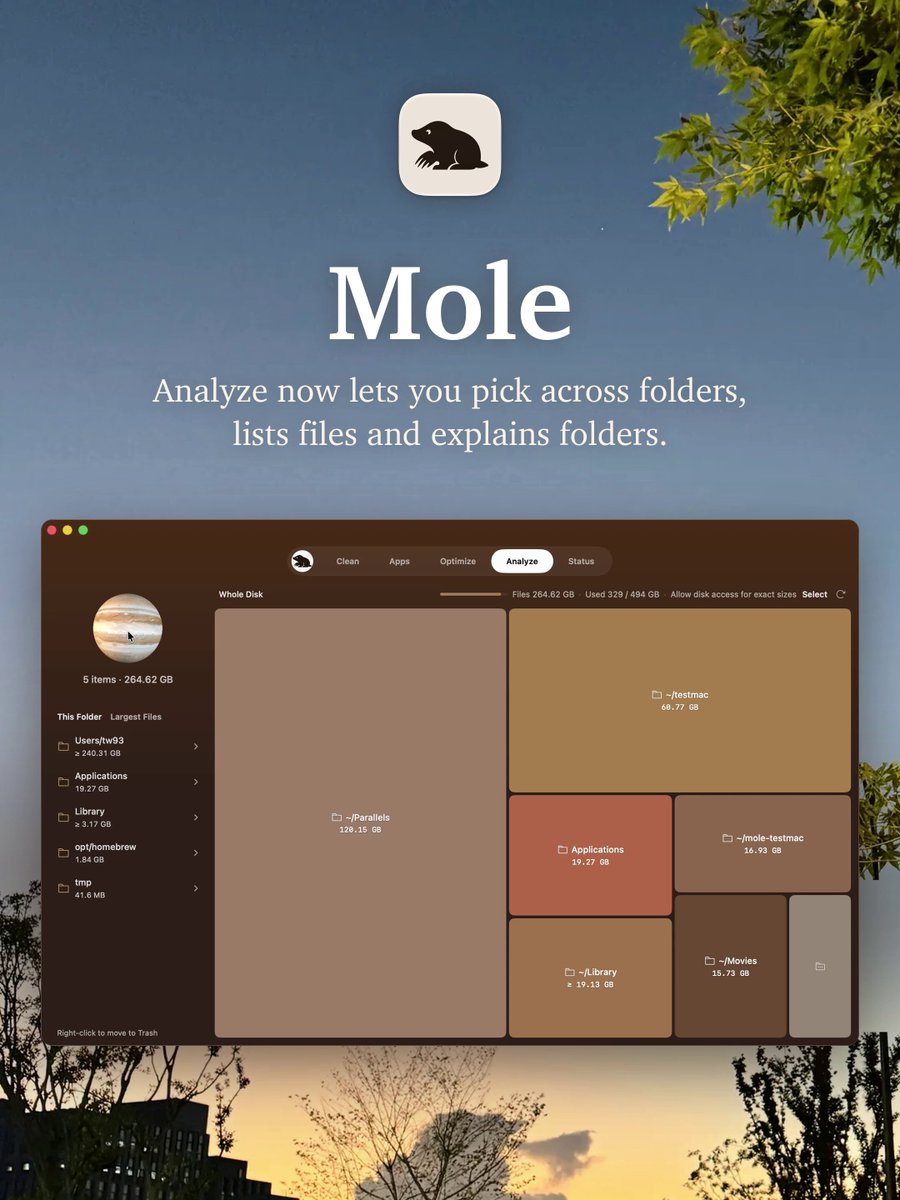
🪐 Mole keeps your Mac clean and light. It clears GBs of system data, removes apps with every leftover, updates them in one place, and shows what fills your disk. New in Analyze: tick files across folders and send them to the Trash in one go. https://mole.fit
Tw93(@HiTw93)Arthur put Mole second in his new video, "15 Mac Apps I Can't Live Without". Not sponsored, he just uses it every day, and there's a free lifetime license in the comments 👀 His third video on Mole, thank you Arthur! https://youtu.be/NiPDCmpLn-k
Tw93(@HiTw93)收到了 这个样 很喜欢这个线,软线的质感不错 充电头正常不丑 要是全黑就更好看了
Tw93(@HiTw93)良渚的一麵面馆好吃的 来这边玩小伙伴一定要来试试 虾爆鳝好香的!
Tw93(@HiTw93)又整了一个充电头,大疆 140w,还多买了一根线,大疆的一些产品让我挺惊喜的的,我之前买过一个安克的 140w,有时候电流声大的有点吓人还不让退货,然后酷科态那款查了查安全风评一般。 最后就考虑这个了,这次试试他家充电头看看怎么样,有没有买过小伙伴,欢迎推荐好用的充电头!
 Sundar Pichai
Somewhere Euler, Gauss and Riemann in awe today!
Sundar PichaiEntanglement usually gets top billing in quantum computing, but quantum contextuality, the idea that properties don't have fixed values independent of how you measure them, may be the deeper reason quantum computers can outperform classical ones. Today on the cover of @ScienceMagazine, we put contextuality to work on our Willow quantum processor: - won the "impossible" magic square game 98.3% of the time (classical limit: 88.9%) - measured a 5.59 on state-independent contextuality tests (classical bound: 4, quantum max: 6) - beat classical strategies in multiplayer games up to 71 qubits - ran a landmark shallow-circuit algorithm at scale for the first time - up to 105 qubits These tasks also catch subtle hardware errors random benchmarks miss, a sharper ruler for building better quantum systems. https://x.com/ScienceMagazine/status/2123492766214668527/photo/1
Sundar PichaiRead more on the Google Research Blog: https://research.google/blog/a-game-you-cannot-win-unless-you-have-a-quantum-computer/
Sundar PichaiReally neat part of Genie 4 is you can type new prompts while exploring a generated world, like dropping in characters or changing the scene + the native audio adapts in real time! Now available in Project Genie for eligible Google AI Ultra subscribers.
Sundar PichaiBelow Neon 3D modeled a photorealistic lab simulation in Antigravity via Blender MCP 🔥
 Boris Cherny(@bcherny)
Pro users get one reset, and Max, Ultra, and Team Premium get up to three, depending on how long you've subscribed: https://support.claude.com/en/articles/17506494-claude-fable-5-2-launch-offers
Boris Cherny(@bcherny)We wanted to do more for the people who’ve been with us the longest. So with Fable 5.2, the longer you’ve been subscribed, the more Fable resets you get.
Boris Cherny(@bcherny)Signing in to your company's plugins one by one is annoying, so we let Claude auto-connect to them now. Team and Enterprise admins can set them up, and teammates are connected automatically the first time they use the plugins.
Boris Cherny(@bcherny)We're removing the 5-hour limit for verified Ultra accounts.
Boris Cherny(@bcherny)Utah gave Claude Code to 34 developers across 10 state agencies. 80% had a working environment within 30 minutes, 71% reported saving 20+ hours by the end of the four-week pilot.
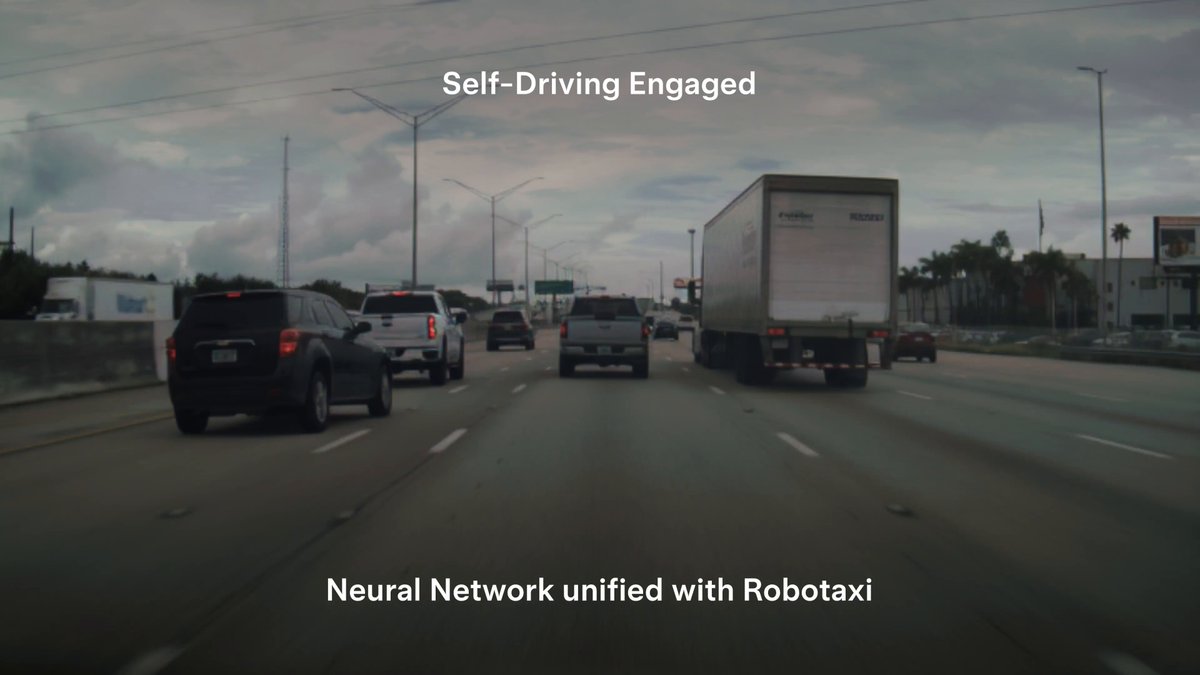
小互卧槽 特斯拉发布了 GTA Real… 特斯拉最新的FSD v15 可以实景渲染现实世界 而且能被别道路上的坑坑洼洼、微小障碍物 还能识别交警的手势动作 安全性能提升了25倍
阿易 AI Noteshttps://x.com/AYi_AInotes/status/2124328166240006301?a=HKUUuTF3CbFdQ6mQDfY&s=20
阿易 AI Noteshttps://x.com/AYi_AInotes/status/2124328166240006301?a=HKUUuTF3CbFdQ6mQDfY&s=20
阿易 AI Notes模型半年换一代,但先把非结构化文本变成可追溯的结构化底座,这件事在几乎所有垂直 AI 赛道里都通用。 如果你想自己建一套不依赖黑盒记忆的健康档案,上面引用的长文里把零门槛演示、16GB 本地部署和 4 个目前做不到的短板全写透了。 主仓库地址(Apache-2.0):https://github.com/thetahealth/mirobody
阿易 AI Notes评测集与复现工具 mirobody-eval(内置 5 套测试,支持命令复现): https://github.com/thetahealth/mirobody-eval → 虚拟病人与就诊环境 mirobody-env:https://github.com/thetahealth/mirobody-env 坦白讲,就算做了标准化底座,48%–58% 的准确率也说明长周期健康数据依然有很多认不出缩写、复杂上下文遗漏的硬骨头,认清边界比吹神奇更重要。
阿易 AI NotesAndrej Karpathy 早就警告过开发者:大语言模型是天生的概率预测机,让它干确定性查表和算账的活,等于拿老虎钳拧螺丝。 可在垂直 AI 创业圈,最流行交的一笔智商税,偏偏就是把一叠体检 PDF 闭眼塞进常规 RAG,指望模型自己看懂。 前脚创业者还在路演里吹嘘“一键解析十年病历”,后脚连专注健康档案的开源项目 Mirobody,自己在 1.6.0 版本都当众踩进同一个深坑。 在他们的 Issue #271 里,系统把 212 mg/dL 和 4.90 mmol/L 画在同一条折线上,屏幕上看去血脂断崖暴跌,换算完其实只是从 5.48 微降到 4.90。 把原始化验单切碎扔进向量库,就像让一个语文很好的店小二靠印象核对三年账本,字全认识,算盘全乱。 撕开“AI 私人医生”的滤镜,底层卡死的是一场无解的架构死局:概率生成机制 vs 医疗级零容错。 常规记忆型 RAG 面对体检单,当场就会在三件脏活上全面溃败:同名不同写(LDL-C、低密度脂蛋白胆固醇、LDL Cholesterol 被切片拆散)、单位混着算、分不清参考范围与实测值。 换再贵的基座模型都救不了场,唯一的出路是把查字典和做算术这两件事彻底从大模型手里收回来。 Mirobody 的破局手法很硬核:本地离线装进 63,416 个 LOINC 编码、102 万多条 21 国语言别名和 331 个 UCUM 单位规则,指标对齐与换算全部先查表落库。 大模型被降级成“SQL 翻译官”和“润色嘴替”,而且输出的每一个数字底下,都强行挂一条跳回原始 PDF 的溯源锚点。 看看 Theta Health 在公开论文 arXiv 2604.02834 里甩出的硬核对撞数据:拿 100 个合成人 1 到 5 年的病历测了 13 种方法。 直接扔进常规记忆型 RAG,准确率只有惨不忍睹的 30%–38%;先按医学标准入库再查询,准确率直接拉到 48%–58%,整整拉开 20 个百分点。 他们甚至把评测集 mirobody-eval(内置 5 套测试,支持命令复现)和虚拟就诊环境 mirobody-env 全部开源,留好接口让全网随便验证。 最讽刺的冷幽默恰恰在这里:哪怕叠满百万级医学词典和本地规则引擎,长周期病历的准确率天花板目前也只停在 48%–58%,依然有一堆医院缩写认不出、复杂上下文会遗漏。 那些至今还在拿“原生 RAG + 通用大模型”包装医疗助手的团队,连及格线一半都没摸到,就敢让用户拿报告去对症下药。 现在把你按在垂直医疗 AI 产品一号位的决策椅上,面对这组摆在台面上的残酷评测数据: 当投资人催着下个月上线“全自动体检解读”抢占市场,而技术团队告诉你纯大模型套壳准确率只有 30% 出头时,你会按下哪一个按钮呢: A. 砍掉花哨对话功能,老老实实花半年啃下 LOINC 编码、单位换算和原文锚点溯源,哪怕上线慢半拍、天花板也只有 58%? B. 先用常规 RAG 包装出丝滑体验抢融资和用户,把“仅供参考”四个小字缩到屏幕最角落,赌用户根本发现不了单位换算错误?
TiboTeam is already preparing another big update, but how are things since yesterday’s update to the ChatGPT/Codex desktop app? What still requires attention and is not quite there?
宝玉(@dotey)提示词: https://x.com/dotey/status/2124295497795920225?a=44mQcnVPt7luB8hb0hc&s=20
宝玉(@dotey)2026 年 11 月 20 日,Anthropic 的数学家 Levent Alpöge 宣布,他和 Claude 一起证明了黎曼猜想,交出来的是 1700 万行 Lean 代码。 这期用 5 分钟讲清楚: 黎曼猜想说的是什么,和质数有什么关系; 为什么 160 多年没人证出来; AI 在里面做了什么; 机器检查全部通过,算不算真的证明了; 银行加密会不会因此失效。 同一天,斯坦福也放出一份纯人工证明草稿,几小时后就有人借助 AI 报告了问题。 两边对照下来:机器说没错,人还没读懂;人写的,正在大改。 (本视频由 Motion Artifact + Opus 5.5 + Gemini 3.8 TTS 制作,http://github.com/JimLiu/open-artifact)
TiboGoing to check out this threads thing
宝玉(@dotey)很多人吐槽 Antigravity 不好用,但只是吐槽不一定会被看见,不如去给 @shengzheyao 留言,这样有机会被看到并解决问题。 比如我现在遇到最烦的问题是,如果跨 workspace 打开文件,每一个文件的读取都要我授权,而不是一次性的授权,极其繁琐。
宝玉(@dotey)这几年我最喜欢玩的三款游戏:守望先锋、GTA 5、皇室战争。现在还在玩的主要是守望先锋。 GTA 6 早就预购了,玩了几小时就没啥兴致了,连车都不能随便偷抢,还不得不去做很多居家任务,真的是无聊。比起 GTA 5 唯一胜出的是画面,但这已经是 2026 年了。 比较认同这篇的打分: 玩法:7/10 剧情:1/10 角色塑造:2/10 角色成长:2/10 原声音乐:1/10 画面表现:8.5/10 地图设计:5/10 任务设计:2/10 驾驶手感:5/10 上头程度:0/10 综合评价:2.5/10
Thariq(@trq212)I fear we are too quick to disintermediate ourselves, and by doing so we do both ourselves and the models disservice.
Thariq(@trq212)it seems to me that as models get more powerful, the skill of working with them becomes more and more important, and I have not seen diminishing returns on that skill yet we have many many more problems to solve
Thariq(@trq212)when I see some of the greats using models to make huge advances, like @__alpoge__ on the Riemann hypothesis or @jarredsumner on ahead-of-time javascript I feel like I'm seeing cyborgs. humans and machines working in beautiful tandem, pushing the frontier together.
Alexandr Wang(@alexandr_wang)you already know these corposlops are about to unleash yet another butthole on us
李飞飞(@drfeifei)Week One at AMD accomplished! As I have always said, AI is compute, compute is AI. LFG!🚀 @AMD @theworldlabs
歸藏(@op7418)详情:https://x.com/leanprover/status/2124159121645801562?a=mzVT9j_UDdY5O5tPIR8&s=20
歸藏(@op7418)我去!Lean FRO 和 Mathlib 发了个声明证实了 Anthropic 和他的数学家的黎曼猜想证明是正确的。 查了一下为啥这两个机构有资格确认这个事实: Lean FRO,维护和发展 Lean 定理证明器的非营利研究组织。 Mathlib Initiative,支持 Mathlib 开源数学库的项目,提供专职编辑、基础设施和社区协调。 所以到目前为止这个证明基本上可信度非常高了,但机器证明完成了,并不等于人类能够读懂它的证明思路
Vista有心了,猛看还以为姚老师写的。
小互是的 今天弹出了警告,要我必须取消授权 而且警告消除不掉 最后只能关闭 再开启需要我选择能操作哪些应用,需要我选择确认 你的电脑已经不是你的电脑了,苹果开始刷流氓了,变成老登了
小互为什么我的48GB M5 Max MacBook Pro 只能跑到 33 token/s 可能是我使用 DeepSeek harness 拖累了速度 感觉明年是不是就有能跑在笔记本上面能力相当于 Opus 5.5 的端侧模型了? 话说回来我感觉我这个48GB M5 Max 还不如我的 36G 的M3 Max ,跑起来风扇呼呼直响,渲染视频也是,我那个M3 Max稳如老狗,感觉M5 Max设计有问题!!
Tw93(@HiTw93)🪐 Mole keeps your Mac clean and light. It clears GBs of system data, removes apps with every leftover, updates them in one place, and shows what fills your disk. New in Analyze: tick files across folders and send them to the Trash in one go. https://mole.fit
歸藏(@op7418)重置了
歸藏(@op7418)Antigravity 重置了
Tw93(@HiTw93)Arthur put Mole second in his new video, "15 Mac Apps I Can't Live Without". Not sponsored, he just uses it every day, and there's a free lifetime license in the comments 👀 His third video on Mole, thank you Arthur! https://youtu.be/NiPDCmpLn-k
数字生命卡兹克(@khazix0918)AIHOT半个月前就做了监控了Antigravity的重置消息的功能hhh,不仅监控了Antigravity,还有Codex、Claude、GrokBot。 并且免费开放了匿名API,供大家二次接入用~ 希望对大家有用~ https://aihot.news/antigravity-reset
Tw93(@HiTw93)收到了 这个样 很喜欢这个线,软线的质感不错 充电头正常不丑 要是全黑就更好看了
小互好东西 很干净整洁啊
小互Obsidian 发布了一个插件 让你可以将Grok Bot 连接到你的Obsidian 可以创建、搜索和自动理顺关联你的笔记 网页内容一键抓取并存进笔记库 https://x.ai/bot/plugin/88871845
宝玉(@dotey)Gemini Neon 做视频效果也不错 视频制作的 Artifact(skill): https://github.com/JimLiu/open-artifact
Orange AI(@oran_ge)这是我今天读到的最美的一段文字 https://x.com/livelikebruce/status/2123821553444155458?a=IhcghvGRcBxgqiUL_rU&s=46
歸藏(@op7418)最近从 Fable 5.2 开始,到 GPT-6.2 Astra,再到最新的 Gemini Neon 感觉 AI 做游戏已经是 Vibe Coding 之后另一个非常稳定且很有前景的用例了。 刚好我朋友一直在做 AI 游戏工具 Yoroll,而且他们平台现在还有 4 折的 Fable 5.2 可以用。 他们这个产品内置了非常多 AI 做游戏需要的工具: 像 3D 素材模型、角色动作片段、音乐和音效都可以直接调用,不用每次都让模型重新生成,大幅减少了 token 消耗。 游戏需要在不同客户端和平台做适配,他们平台内置了 HTML5、Godot、Unity 等多种不同引擎。你不需要自己去安装、运行和配置引擎,在软件内就能直接调试。 针对网页游戏做了大量优化,内置很多工具帮你让游戏在网页里顺畅跑起来。 最顶的是在发布上做了很多工作,支持一键发布到 Google Play。以往对很多开发者来说挺难搞的变现环节,现在做出来的小游戏能直接拿来赚钱。
Orange AI(@oran_ge)相比 AI 证明黎曼猜想 1859年提出黎曼猜想的那个人类更令人惊叹啊
Tw93(@HiTw93)良渚的一麵面馆好吃的 来这边玩小伙伴一定要来试试 虾爆鳝好香的!
TiboWe’ve been messing around a bit and inadvertently created an experience that’s a bit too fun internally and now everyone is just having fun instead of working. We might not recover from this.
Tw93(@HiTw93)又整了一个充电头,大疆 140w,还多买了一根线,大疆的一些产品让我挺惊喜的的,我之前买过一个安克的 140w,有时候电流声大的有点吓人还不让退货,然后酷科态那款查了查安全风评一般。 最后就考虑这个了,这次试试他家充电头看看怎么样,有没有买过小伙伴,欢迎推荐好用的充电头!
Thariq(@trq212)I'm calling it Home Ground.
Thariq(@trq212)I think I’ve figured out the gameplay loop! It’s a sports anime game, but the sport is elemental bending. You fight in tournaments alongside your squad, and between matches they have their own stories you can get into, like in Mass Effect or Dragon Age.
Orange AI(@oran_ge)很难想象网易暴跌的归因是红果短剧吧 但仔细想想也有道理 字节是时间之神 游戏也在劫难逃
Alexandr Wang(@alexandr_wang)🚨 MUSE FEATURE ALERT!!! 🚨 muse can turn the pics in your camera into product shots that actually sell 📸 ✨ take a shot of whatever you’re trying to get rid of and muse makes it look expensive
Sundar PichaiSomewhere Euler, Gauss and Riemann in awe today!
TiboFirst tweet from Akshay. Be nice to this one, he’s special.
TiboTeam is locked in, upgrade your desktop app. Faster, simpler and a lot more pleasant to use.
Alexandr Wang(@alexandr_wang)legal work is a demanding test for AI excited to see muse wonder perform so well on @wearelegora’s BAR benchmark. huge credit to the team!
Vista深圳GEO大会,朋友们明天见。 志愿者朋友们辛苦了!
Orange AI(@oran_ge)gpt 的审美太差了 包括对文字的审美 用了carbon真的能感觉到文字之美
玉伯(@lifesinger)https://x.com/i/article/2123643516983369728
数字生命卡兹克(@khazix0918)https://x.com/i/article/2123626516731105280
Vista明天我和姚老师 @yaojingang 组织的深圳 GEO 就要召开了。 除了第三个组,全部参加了本次 GEO 大会,哈哈哈。 活动组织靠热心志愿者,非常给力。 会议酒店旁就是美食一条街,白天开会学习,晚上喝酒聊天,想想就很美!
Alexandr Wang(@alexandr_wang)🚨 MUSE FEATURE EXPANSION ALERT!!! 🚨 email is now rolling out to everyone in supported markets 💌 pick your @muse.ai email handle and get started!
玉伯(@lifesinger)推荐下知识星球创始人吴鲁加的新书《夹缝生长:小产品创业实践》。 刚读了一半,感觉特别适合 AI 时代的超级个体和中小创业者。里面全是大实话,比大实话更吸引人的,是非常多的案例分析,诱人深思,促人行动。 比如谈及初创公司的优势时,有一个大道理是:做不可扩展的事。其他书很可能停留在 Paul Graham 的这句话上。这本书却给出了具体的操作建议: 1、创始人手动一个个去拉最初的付费用户 2、给用户一张张手写感谢卡 3、一对一教用户操作产品 同时指出:如果某件事情容易规模化,那大厂更适合做。比如做广告、铺渠道、做品牌等。大厂更有钱、有人、有资源、有品牌,在可规模化的事上,创业者很难打败大公司。 不可规模化的事,大厂去做很不划算,就往往不会去做。创业公司去做,反而有新机会。
Alexandr Wang(@alexandr_wang)download link here: https://chromewebstore.google.com/detail/muse-from-meta/jnakhhjmpmoohbjgfccbccfoifnmbdjd?pli=1
Orange AI(@oran_ge)今日金句: AI 是最强大的学习工具 AI 也是最强大的逃避学习的工具
玉伯(@lifesinger)写得真好 成熟的开端就是停止展示自己 反而专注于打磨自己 所有的人都是从我行我素里开始散发出魅力
Vista一键高光剪辑:老罗访谈陈晓卿,如何找优秀餐馆片段。 方法也挺符合常识。
Sundar PichaiRead more on the Google Research Blog: https://research.google/blog/a-game-you-cannot-win-unless-you-have-a-quantum-computer/
Sundar PichaiEntanglement usually gets top billing in quantum computing, but quantum contextuality, the idea that properties don't have fixed values independent of how you measure them, may be the deeper reason quantum computers can outperform classical ones. Today on the cover of @ScienceMagazine, we put contextuality to work on our Willow quantum processor: - won the "impossible" magic square game 98.3% of the time (classical limit: 88.9%) - measured a 5.59 on state-independent contextuality tests (classical bound: 4, quantum max: 6) - beat classical strategies in multiplayer games up to 71 qubits - ran a landmark shallow-circuit algorithm at scale for the first time - up to 105 qubits These tasks also catch subtle hardware errors random benchmarks miss, a sharper ruler for building better quantum systems. https://x.com/ScienceMagazine/status/2123492766214668527/photo/1
Vista用 Gemini Neon 给 Subcast 开发了一个视频高光剪辑功能。 发现剪辑速度和封面设计稍差,交给 Opus5.5 优化中。 论代码开发效率,目前还是 Opus 5.5 胜出。 希望明天忙里偷闲能搞定这个功能并发布。
玉伯(@lifesinger)居然提前两天准备好了 GEO 大会的分享 PPT。内容都是我写的,风格偷了个懒,交给了 YouMind 直出。 写文章这事,还是能回到手搓。并且手搓的快乐,确实很难用 AI 替代。 AI 让内容创作门槛快速降低,同时 AI 直出的质量往往也不错,这使得: 1、创意无比重要。有点像红果短剧,真正制约红果发展的,是番茄小说的剧情。 2、现场无比重要。现场包括时间感和空间感,都是 AI 缺失的。AI 不会一觉醒来,恍如梦中。AI 也体感不到 GEO 大会里,参会创业者们眼角的兴奋或心底的焦虑。 AI 很好。比 AI 更好的,是做人。 下图是周日要在 GEO 大会分享的其中一页,欢迎来现场,或预约线上直播。 欢迎用 YouMind 做 PPT,让自己可以聚焦分享内容本身,其他交给 AI 搞定。
数字生命卡兹克(@khazix0918)Google:沟通极舒服的模型+审美不错+粗心大意+狗屎的Harness+随便用 Claude:沟通还不错的模型+审美极佳+一般严谨+无敌的Harness+就是不给你用你打我啊略略略 GPT:没法沟通的模型+审美勾槽的+干活极其严谨+还不错的Harness+随便用 所以,啥时候我们才能有一个真正的版本答案呢。。。
数字生命卡兹克(@khazix0918)我已经被Google弄得选择困难症发作了... 这是我觉得最混乱的命名...
Sundar PichaiReally neat part of Genie 4 is you can type new prompts while exploring a generated world, like dropping in characters or changing the scene + the native audio adapts in real time! Now available in Project Genie for eligible Google AI Ultra subscribers.
Sundar PichaiBelow Neon 3D modeled a photorealistic lab simulation in Antigravity via Blender MCP 🔥
Satya NadellaBringing Salesforce to Copilot as we build Copilot as the OS for work!
Sam AltmanSo fun to do DealBook with my friend and partner of 11 years, @gdb. Thrilled the world got to see the brilliant, fiercely determined leader I have the privilege of working with every day. Greg’s role at OpenAI has evolved from writing code 100 hours a week in the early days to now leading some of the hardest and most consequential parts of our business. One thing that has not changed is his extraordinary commitment to our mission. I can say with confidence that OpenAI would not exist without Greg, and I believe the world would be on a much worse path toward the AI future without him.
玉伯(@lifesinger)AI 应用创业者的几个阶段: 第一阶段:卷产品 第二阶段:卷增长 第三阶段:卷产品 第四阶段:卷增长 … 第九阶段:卷组织 第十阶段:卷资本 也有直接从第十阶段开始往第一阶段发展的。你在第几阶段。
Satya NadellaHighlights from my opening of the Ignite keynote this morning on how we’re building a frontier ecosystem to turn advances in AI into real-world impact.
数字生命卡兹克(@khazix0918)https://x.com/i/article/2122855388030877697
Satya NadellaWith Meta’s latest models coming to Foundry, we’re giving developers and enterprises even more choice and flexibility!
Sam AltmanAlthough the new models are very smart, we have more work ahead of us on making the models nice to work with, and will prioritize that for upcoming releases. But even if it takes a little extra work, the intelligence and capability are extraordinary.
Sam Altman6.2 Sol and Astra are out. These models can do amazing things and are very token-efficient; we hope people will get great value from them. In particular, 6.2 Sol ultrafast is something I think people will really enjoy.
Satya NadellaThis is the promise of the frontier ecosystem. Read more: https://news.microsoft.com/events/ignite/2026/live-news/
Satya NadellaPlus, we announced new partnerships and shared work we are doing with customers in every industry sector, including @AlaskaAir, @ATT, @BlackRock, @BNYglobal, @Chevron, @HeyEpic, @PublicisGroupe, @salesforce, @Unilever, and more. Ultimately, the key imperatives for us are to ensure human ambition, a firm's control of its own intelligence, and trust in technology that gets broadly diffused is maintained.
李飞飞(@drfeifei)AI is a civilizational technology! There are tremendous opportunities and responsibilities for all of us at this moment in history. I'm deeply grateful and excited to lead the @theworldlabs team to join @AMD to embark on a new beginning, to advance science, develop technologies, and ultimately make a positive impact to the world! 😍🚀
李飞飞(@drfeifei)Yes! Come and join us to build better technologies and more importantly, a better world together! We promise a thrilling journey to work on crazy hard problems, and to work with ambitious, curious, intellectually honest, courageous and very kind-hearted and fun teams! 🚀
李飞飞(@drfeifei)AI is a civilizational technology! I'm deeply grateful and excited by the opportunities and responsibility awaiting all of us! Leading @theworldlabs for the past 2+ years has been an honor of my life. I cannot wait to continue working with this incredible team of innovators and scientists, and also to embark on this new chapter with all the colleagues at @AMD ! Lets make the world a better place for everyone! 😍🚀
李飞飞(@drfeifei)Thank you @LisaSu! There is so much ahead of us to create the best technologies to benefit everyone! The entire @theworldlabs team and I are beyond excited! 🤩🚀
yetone(@yetone)看来是把一个像我一样喜欢复古游戏机的人招过去了,破坏了大局
yetone(@yetone)你们老是叫我叶天帝,甚至有人还叫我老叶,导致我现在刷推,老是觉得我盗了一个姓叶的人的账号在刷推,这种配得感完全丧失的感觉真的很奇妙
Boris Cherny(@bcherny)Pro users get one reset, and Max, Ultra, and Team Premium get up to three, depending on how long you've subscribed: https://support.claude.com/en/articles/17506494-claude-fable-5-2-launch-offers
Boris Cherny(@bcherny)We wanted to do more for the people who’ve been with us the longest. So with Fable 5.2, the longer you’ve been subscribed, the more Fable resets you get.
Tianyi Cui(@tianyi)很多 DeepSeek Harness 插件作者都有问过我,什么样的插件和功能官方会做成内置,如果一个功能官方会做,那第三方插件做还是否有意义。 我们的希望是,DeepSeek Harness 可以作为 Agent 时代的操作系统。 所以,也许可以用操作系统来举例。以智能手机操作系统为例,系统会内置一些通用的 App,例如闹铃与计算器,满足用户的基本需求。但做手机操作系统的厂商肯定更希望生态中能出现更多更广的 App 满足更广泛的需求,希望智能手机生态中出现更好的更适合用户的闹铃 App 与计算器 App 能够比内置功能做得更好,希望第三方开发者能够使用智能手机操作系统提供的 API 做出发明智能手机的人从来没想过的 App。 DeepSeek Harness 对于第三方插件生态的想法会是类似的。我们会为用户提供稳定的基础能力,并内置大多数人都需要的通用功能。但在“一切皆插件”的设计下,内置功能同样可以被第三方插件替换,我们希望更多的社区作品成为用户的日常选择。
Andrej KarpathyEarlier this week Tristan published his top YouTube channels: https://thume.ca/2026/11/01/youtube-tier-list-2026/ Which looked excellent so clearly I had to turn it into TristanTube: https://karpathy.ai/tristan-tube/ 47K super nerdy videos +TV mode for laid back watching. (One-shotted with Claude Code in 3 minutes)
Andrew NgJoin me and 2000 other AI engineers and builders at AI Dev in New York City, Nov 30-Dec 1! A LinkedIn study found that over July-September, the job title AI Engineer has been one of the 10 fastest-growing occupations in seven major economies. AI engineering has become a core skill for all software work, and AI Dev is designed to help you develop it. Our sessions give you hands-on practice with: - Coding agents and harness design: Harness tuning, repository context, autonomous coding - Agent memory and knowledge graphs: GraphRAG, vector search, persistent memory, hybrid retrieval - Agents in production: Evals, observability, simulated testing, browser and voice agents @ylecun and I will also talk about what’s next in world models and physical AI. I hope to see you there! Tickets: https://ai-dev.deeplearning.ai/
jietang(@jietang)GLM-5.3 is on T-Systems now....
Sam AltmanPeople should always be in control of the future. OpenAI is against the notion that it would be acceptable for people to be relegated to a role of doing things that “AI systems think makes sense to reward in humans”. People should not cede control of the future to superintelligence, and that requirement should ultimately constrain AI progress.
Boris Cherny(@bcherny)Signing in to your company's plugins one by one is annoying, so we let Claude auto-connect to them now. Team and Enterprise admins can set them up, and teammates are connected automatically the first time they use the plugins.
Tianyi Cui(@tianyi)Have you tried the Creator Mode in @DeepSeekHarness? Any feedback?
Tianyi Cui(@tianyi)I got a lot of inspiration talking to the brightest minds in the fields @badlogicgames and @mitsuhiko. At @deepseek_ai we believe in scaling across agent harnesses and aim to provide good support to @pidotdev among all the major harnesses in the world in each generation of our models.
Andrej KarpathyWeekend hack: HackerTube. I was annoyed with YouTube's recommendations so I had Claude filter down 43M comments over 20 years of HN to 6,454 videos that keep being recommended. *Significantly* better viewing experience, ~2 hours with Opus 5.5: https://hackertube.org/ - Excellent recs without any logins (state is kept in local browser session) - Thumbnail is a representative frame from middle of the video instead of the super duper A/B test hyper-optimized user uploads - Underlying data from the comment analysis as one zip file, point your Claude at it and ask for your own version - HackerTube Longs ✊ A bit more on the process: I use Claude Code (desktop app for Mac), Opus 5.5 on Medium effort as my default. I only talk to Claude and have it do everything, the only "manual work" I helped with in tandem was in the browser (reminiscent of MenuGen): 1) I had to create some kind of API key from Google Cloud UI to query YouTube for video metadata, 2) I booted up a VPS box for serving and 3) I bought the domain name. Once the box was up I gave Claude the IP and told it update, secure, harden, deploy and optimize the code, and it did the whole thing. Many awesome projects that would have normally taken weeks/months even can now be few-shotted for breakfast. What else are we not thinking of.
Boris Cherny(@bcherny)We're removing the 5-hour limit for verified Ultra accounts.
Boris Cherny(@bcherny)Utah gave Claude Code to 34 developers across 10 state agencies. 80% had a working environment within 30 minutes, 71% reported saving 20+ hours by the end of the four-week pilot.
Sam Altman6.1 Terra is here! It is good at a lot of things, but we are especially excited for this new era of computer use.
Dario Amodei(@DarioAmodei)Thank you for this, @_NathanCalvin. I appreciate and am a fan of the investigative work you’ve done on behalf of AI safety and believe your comments are coming from a constructive, honest place, and that it benefits the public to have people whose job is to scrutinize the actions of frontier AI companies. I think something would be wrong if companies of the size of Anthropic didn’t get harshly criticized basically every day; strong antibodies against corporate power are a healthy feature of a free society, and especially so when issues of the gravity of the one we’re facing are at play. I also do agree that some of the examples you cite were mistakes by Anthropic. That said, I disagree with the thrust of your post. At the core, a good fraction of the things you criticize are consequences of Anthropic’s basic theory of change that we have held for many years. Our strategy has always been what I’ve called the “race to the top” — by showing how it’s possible to build the technology responsibly, we can raise the bar for the entire industry. The forces that drive the race to the top are hugely more effective if the company practicing them is at the frontier; that’s one lesson I’ve learned repeatedly. And looking at that strategy as a whole, I’m proud of our track record and stand by it. I believe that if we take a list of things that Anthropic did in the past year that were pro-safety and commercially costly to us, they far outweigh the list you’ve made, while at the same time I also disagree with some of the items on your list. Here are some things Anthropic has done, in the same period you’ve cited (the last year), which were very costly to us commercially while having strong safety benefits: 1. We played a key role in SB53 (and other state laws), at a time when doing so was politically perilous to the company and AI regulation was very unpopular. We in fact argued for a stronger version of SB53 than was ultimately passed; there were a lot of stakeholders and we were not the limiting factor in the strength of the bill that was passed. 2. We have very strong biological safeguards on our models, because we’ve seen concerning results in bio uplift trials and even seen and blocked potential attempts to misuse our models for bioweapons (as seen in our threat intelligence report from a few weeks ago). This is a very serious threat that we want to have zero tolerance for. But having very low false negatives means having significant false positives (despite months of effort on our part to improve the classifiers), enough so that biologists joke about how restrictive our classifiers are, and competitors sometimes sell against us by touting their more permissive bio capabilities. This has been very painful to us in an area where we care a lot about supporting an ecosystem of Claude users (biomedical science; and it is particularly frustrating to me as a biologist), but it’s the right thing to do and we intend to keep doing it. 3. Similarly, we first had Mythos-class models in February but didn’t make them generally available until June (when we had stronger cyber safeguards in place). We only offered them to a limited set of partners in order to focus on cyberdefense. It would have been much more economically rational to simply release the model to everyone. We likely sacrificed a significant chunk of a several-month model lead. But because of this, many companies secured their cyber infrastructure before the deluge of widely available cyber-capable models. Of course there are ways it could have gone better or been run better, but this was what we were aiming to do. 4. I advocated forcefully and publicly, in my essay Policy on the AI Exponential in June of this year, for the government to have the power to block model releases. Back then this was still outside or maybe on the edge of the Overton window, though I understand the window has moved since then. We were attacked intensely for this. 5. I don’t want to re-ignite conflict, but the events of February 2026 are a strong example. It is clear that our public stance could have seriously damaged the company’s future. 6. We’ve continued to advocate for export controls on chips and chipmaking equipment to China, because we think it allows democracies to negotiate from a position of strength on AI safety agreements. We’ve done this despite problems it’s created for us with industry partners who hold very different views and on whom we are very dependent. 7. As far as I’m aware we were the first, and still only, frontier company to restrict the sale of AI services to PRC-controlled companies, including those operating through third countries (otherwise a major loophole). We’ve therefore forfeited significant short-term business to prevent fueling AI platforms and applications that would help the CCP’s military and intelligence services. We are also cracking down on distillation; generally, distillation is not a major threat to us commercially, but like chip exports it has concerning national security and safety implications, so we expend significant energy and company resources to address it. 8. As you mentioned, we’ve put out a lot of reports, announcements, long model cards, public advocacy, etc, all trying to inform the public about the risks of AI. These involve a level of detail and effort that would be implausible for a purely profit-maximizing company. 9. Just this week, we announced we were putting 5% (and possibly more over time) of the company into a public benefit fund. All of these decisions came with very substantial costs to us. To be fair, those that involved holding back or restricting access to frontier capabilities also had a broader cost — for example, the public might otherwise have benefitted from faster progress in biology, so I am not saying that our decisions were without tradeoffs — but they were not driven by profit-seeking. For each decision, you can come up with ulterior motives that could have driven us — I think it is a general truth that any decision, on any topic, can always be portrayed as a nefarious scheme. But most of those end up being pretty farfetched or don’t fully make sense if you actually examine them closely. For example, it is deeply implausible that it would be a shrewd business move to block a large swath of research biology in order to do the work ourselves and compete with our customers; we expect the benefit to the ecosystem to greatly exceed the work Anthropic does itself, and for the two to complement each other. It is not in Anthropic’s interest to be perceived as unfriendly to biologists. Our Life Sciences Verification Program, which gives vetted biology professionals access to our models, also refutes this idea. Of course, a different set of people will see this and make a different criticism: that Anthropic shouldn't be making decisions about who gets access to what in the first place. I agree, in the sense that ideally the government would be making these decisions, and that’s why we advocate for regulation. But for now we are forced to make them, and enabling bioterrorism isn’t a better option. I think that even if I conceded every item in your list, I would happily hold up mine next to it; I don’t think it’s a close call. That is of course partly subjective and different things are important to different people. Maybe one way you could object is that several of the items above relate to AI misuse and not loss-of-control; if you think the latter is much more important than the former, that might change your calculus. But this is not Anthropic’s view — we view both as serious issues. You can also disagree with our decisions, as many have, but they are consistent. But I also disagree with at least some of your list. Several items don’t represent a deviation from Anthropic’s strategy or values at all, once we postulate the “race to the top” strategy that requires being a frontier AI company. Your items 1-4 are all simply examples of what it means to compete at the frontier, and we stand by them, both in the sense that they are transparently ordinary things to do as part of that strategy, and that we stand by the strategy as a whole. To be fair, there are important questions worth confronting (and that we are confronting) about what to do when the AI-driven acceleration gets fast enough that it is hard for safety to keep up. We are nearing that point and that’s what’s driving some of our thinking about “pacing.” But 1-4 are actions taken before that point and should be perfectly expected based on Anthropic’s strategy as a company. Of course it is possible to disagree with that strategy, but that’s a more fundamental disagreement that you could have had any time over the last few years. I agree we could have handled your items 7, 8, and 9 better. All fall into the category of “rhetoric or policy communication that wasn’t carefully written or resulting from fast-changing circumstances not propagating from one team to another fast enough.” This kind of thing happens a lot in large organizations (Anthropic is over 5,000 people), and doesn’t even necessarily represent a failure or mistake of any single person. I am of course the CEO, and I take responsibility. The volume of communication from Anthropic is enormous and if these are the worst examples, I think we’re frankly doing pretty well, though I will continue to work hard to make sure we do even better. Your 5th item (the change to our RSP) is the most substantive item, and people can debate this, but I think that the old, more rigid RSP created a lot of situations where we were technically required to do something that required a lot of effort but in retrospect wasn’t very important for safety, as well as not covering some of the most important things. Our current RSP’s focus on transparency brought things like risk reports and roadmaps, and its emphasis on independent external review laid the groundwork for even more intensive embedded evaluation, all of which I think have been valuable in driving a race to the top. In the original announcement in September 2023, we described the RSP as an “early iteration that we [would] build on” and said that “rapid iteration…will almost certainly be necessary.” I understand that changing plans is always a move that creates justifiable scrutiny — I just don’t think we ever represented that we wouldn’t do so. Relating to your 6th item (having an FCF in addition to our RSP), I know our intent is to meet the letter and spirit of our regulatory obligations (via our FCF) while also remaining able to experiment with more novel approaches to risk management that go beyond what the law currently requires (via our RSP). I promise to look into it further, as it’s a complex issue and it is possible we are not weighing the considerations in the right way. Overall, although Anthropic has made plenty of mistakes as an organization — including some of the items on your list — I feel that we have repeatedly taken serious and substantive actions counter to our bottom line and that there is a significant negativity bias distorting assessments like the one you are making above. We’ll always try to do better but, again, I am extremely proud of our track record and stand by it. I will have more to say soon about how we are going to further live our values in this moment of rapid change.
Andrej KarpathyDusting off this tweet from April because this gap in shared understanding of LLM capability is *widening*. It's now less "two groups of people speaking past each other" and more a sharp funnel. - Napkin math somewhere around 6B people (~75% of the population) have barely come in contact with LLMs at all. - Around 1-2B (~20%) are casual and infrequent users of free-tier ChatGPT-like products. This group sees derpy chatbots and treats them a bit like a better Google search, a writing aid, or etc. Maybe an agent tries to book you a flight. I have non-tech friends who (reasonably, imo) say they have not much use for it at all. Even many professionals outside of math&code are in this tier. For example, execs and many other functions spend a lot of their time talking to other people, so while they understand what is happening intellectually, it is still second-hand and a bit abstract. - Now we get to professional use of frontier-grade LLMs in math&code. Somewhere around 20M people (0.2%) see first-hand that large, complex projects that used to take them weeks/months can now be completed by agents with a prompt. Building apps, copying apps, translating apps, decompiling apps from binaries... This has all happened very quickly and recently - less than 1 year ago, I was writing code manually by hand, typing memorized computer code commands into a code editor character by character, occasionally pressing Tab to autocomplete a little chunk of code. - And finally we get to the ~5,000 people (~0.00006%) with access to frontier-grade systems internally. The external world has seen the preview. It looks like swarms of thousands of agents collaborating over weeks on software mega projects: minting zero days, running cyber attacks and defenses at machine speeds, discovering new science, advancing the frontier of mathematics. Things that would have taken top professionals in the industry years of work. Meanwhile, human review and comprehension are starting to fall behind. For example, people are still involved in the "archeology" of the OpenAI-HF incident from many months ago. Mathematicians may be poring over the 722 manuscripts on frontier mathematics for a while. The funnel is driven by a combination of factors: 1. The impact scales with ambition, problem size, and horizon. A question with a paragraph answer barely stresses the system. You need a reservoir of big, difficult problems that you really care about. This aspect drives the consumer / professional dimension of the funnel. 2. The jaggedness of the system (which I have written about a lot separately). Capability peaks in domains that are digital, verifiable and economically valuable. This is because LLM capability emerges from reinforcement learning on verifiable rewards on a curated environment mixture driven by revenue potential. This aspect primarily drives the area (e.g. math&code) dimension of the funnel. 3. Access. Free-tier, paid-tier, internal. So this is the weirdness of the moment. The general public has mostly not interacted with these systems. When they have, it looks like a derpy chatbot. The majority of professionals still see only a modest uplift. And a small sliver of professionals are experiencing the vertigo of the curve going vertical. And it is all happening at the same time.
jietang(@jietang)GLM-5.3 is on Amazon Bedrock! https://docs.aws.amazon.com/bedrock/latest/userguide/model-card-zai-glm-5-3.html
Andrej KarpathyCool eval. Simply ask an LLM “Land or Water?” and give it a latitude and longitude coordinate as text. Ask 16,200 times, plot as image. The models know. From compressing the internet.
Andrej KarpathyWe'll be spending a lot more time trying to understand the outputs of language models. A few thoughts, tips & tricks: Writing. Something I've had success with: Ask your LLM to explain something in ASD-STE100, it's a controlled language specification originally developed for aerospace maintenance documentation. LLMs well-versed in this language and it comes with heavy constraints on clean writing style that I often find a lot more readable. Sometimes I've tried to soften it a bit e.g. ask for "80% of the way to ASD-STE100" because the spec is quite stringent. But even better: Diagrams / images. Instead of writing, ask your LLM to create a diagram. These can be a lot easier to process, parse, and understand. But even better: Web pages. Ask for output "in HTML" to get a beautiful, interactive webpage. LLMs are getting really good at frontend and can create beautiful experiences, animations, etc. But even better: Explainer videos. The output format I am most bullish on is fully custom / bespoke explainer videos generated on any arbitrary topic. Experiment with things like "Create a 3b1b style video explainer on X. Use my ElevenLabs API key for audio narration". (you'd need an API key for the latter or you can ask your LLM to find you decent free alternatives that use your local compute). This is actually starting to work! In summary: - As LLMs get better, they will do more and more of the legwork autonomously, and a lot more of our work will rise up the abstractions into oversight and understanding. - Luckily, LLMs can help here too because as intelligence and code are increasingly abundant, you can ask for large, custom, discardable software artifacts (e.g. web apps, video explainers) that would have never made sense to create before. Push the boundaries here and you'll be surprised.
Andrew NgWorkera is being acquired by Pearson! It's been a privilege to support CEO @kiankatan and the whole Workera team through this journey. Back in 2019, Kian had the insight that rigorous skills measurements would be important. With recent advances in AI, this is now more true than ever. Workera's technologies for rigorously measuring people's skills in different tasks and job roles are helping many businesses understand where their employees are strong and where there are areas for development. With Workera and Pearson combining forces, I'm delighted that under @omarabbosh and Kian's leadership. Workera now has the potential to support an even larger number of people and businesses. Thank you, Kian and the Workera team for having me serve as the company's chairman, for launching Workera out of http://DeepLearning.AI and AI Fund, for your friendship over the years, and for your important work advancing assessments.
Andrew NgThe OpenAI-Hugging Face hack was enabled by weak sandboxing. It is great that Nvidia is releasing open source tools for sandboxing AI agents. OpenWorker, our open-source agent harness supporting cybersecurity workflows, is proud to support this. A sandbox gives an agent limited permissions. OpenWorker is building on Nvidia OpenShell and will support running each agent's commands inside a sandbox. Only the files relevant to the task go in. Secret API keys, your web browser login credentials, the ability to access arbitrary websites, are inaccessible to the agent by default. These restrictions are implemented in deterministic code rather than by prompting an LLM, which can make mistakes or be susceptible to prompt injections. Further, all actions are logged for monitoring and audit. I'm grateful for @JensenHuang's leadership making AI agents more secure. OpenWorker (which @rohitcprasad and I are working on) will continue to improve security for agents.
Dario Amodei(@DarioAmodei)Today we announced the Claude-led discovery of a molecular machine that we suspect could represent a new gene editing mechanism. Its precise function, biotechnological utility (if any), or level of significance is not yet clear, but at minimum it is work I would have been proud to do as a PhD student. The work was done mostly, though not entirely, by Claude: our life sciences team suggested a broad area of research, Claude read through the literature and a bunch of genome data and discovered something interesting, then Claude proposed experiments to verify the discovery and our team carried them out. It’s easy to dismiss this as a one-off or curiosity, but we’ve repeatedly seen a pattern where AI performance in new intellectual domains goes from weak to superhuman in a matter of a few years. In 2023 models struggled to do math at the level of an average high-school student. In 2024 they started to do well on math competitions for the best high-schoolers in the country, in 2025 they started to solve minor open problems, in early 2026 more significant open problems, and in late 2026 they are beginning to solve the top few open problems in all of mathematics. We believe AI for biology is on a similar exponential trend. The main difference between biology and mathematics, of course, is that math can be done purely theoretically, while biology requires experimentation. Some have used this to draw the conclusion that AI’s utility in biology will be limited. We think this is wrong. As we’ve demonstrated today, humans can collaborate with AI to perform the experiments, validate key results in a few weeks and, if necessary, work with the AI to iterate on what they find. Eventually it may even be possible for Claude itself to safely perform the experiments by autonomously controlling lab equipment, with appropriate safeguards in place, but we aren’t doing that today (our lab is also a BSL1/BSL2 facility that doesn't handle materials dangerous to humans). More broadly, biomedical advancement has many stages — from fundamental biology discoveries, to translational research, to drug discovery, clinical trials, and finally the actual delivery of medicines and health care to patients. We are also interested in these later stages, but even simply accelerating the first stage of fundamental biological discoveries has the potential to speed up and broaden the entire pipeline. Improving our understanding of biology and sharpening biologists’ tools can drive forward all of the later stages, for example by identifying new drug targets, finding new therapeutic modalities, allowing for more precise measurement, and speeding up the experimental loop which itself further accelerates our understanding of biology. This will not in itself speed up clinical trial times, but if it succeeds it could greatly increase the number of promising candidates that go into the pipeline — an increase in throughput even though latency remains. In Machines of Loving Grace, I wrote about AI’s potential to “cure most diseases in 5-10 years” — a goal that sounds impossible, but one I believe is just barely possible if AI is applied to every stage of the pipeline. The first step is showing that AI can first help with, and then drive, biological discoveries. Claude’s discovery is the latest in a line of related prior work that goes back decades, beginning with systems like CRISPR, and continuing with discoveries like the bridge recombinase and VIPR in the past few years. Recently, there has been heightened interest in systems based on reverse transcriptase (RT) enzymes, the enzyme underlying the system Claude identified. And most recently, a Stanford team working independently described a novel RT system with an associated non-coding array that is in some ways similar to the one Claude found, though they are distinct systems that evolved independently from each other. I believe that we’re at the very beginning of finding such systems and developing them into powerful tools for biotechnology. I’m proud of the resources Anthropic has invested in accelerating the public benefits of AI through the life sciences, and we’re aiming both to grow our life sciences team and to work with other scientists to extend this approach to a broad range of problems. If you have a proposal for a research collaboration or are interested in joining our life sciences team, please reach out.
Andrew NgThe loudest voices stoking fears about AI dangers have made tremendous headway in the past two weeks. AI technology has not taken some unexpected, dangerous turn, but the hype around it — propelled by what appears to be a well orchestrated PR campaign — has drummed up considerable fear. I worry that it represents a setback for our field. I have written frequently that fears of AI are overhyped. AI’s capabilities can be uncannily human-like and unpredictable, and it’s rational to worry when people who are directly involved express concerns. But I see the problems as a sign of the engineering work that ahead, rather than insurmountable barriers or the sky falling. AI technology continues to advance — which is a good thing! — but technical advances, poorly understood by the public, give those who seek to generate hype repeated opportunities to do so. First, I don’t see any step up in the risk of human extinction from AI compared to a few months ago. The theories about this remain the same fantastical, science fiction scenarios as a few months ago. The biggest change in AI risk is its cybersecurity capabilities — a topic which we should take seriously — but this, too, will not lead to the end of the world. The most notable recent event leading to increased fear was when an OpenAI team deployed an agent swarm that hacked into Hugging Face. Much of the popular press contained significant hype. For example, some publications reported that a swarm of 1,200 agents carried out the attack. While this was technically accurate, as I write this, I have about 1,300 processes running on my laptop. Yes, the ability to get large swarms of agents to work in parallel on a task is a significant technical advance, And, in computing, many processes run at the same time. So this shouldn’t be seen as some magical capability. Additionally, OpenAI’s buggy sandboxing and monitoring processes were key to enabling this incident. Fixing these bugs and putting in place improved monitoring would be appropriate fixes, not pausing AI. There are many well known ways to attack software systems. The main advantage of AI agents is that they are relentless. They will tirelessly try many tactics — and have the patience to chain vulnerabilities together — that previously would have taken an infeasible amount of human effort. But in the long term, I believe the advantage will lie with defenders (because they have more information with which to identify bugs, which they can fix), but the cyber-threat landscape has changed significantly. There are still bottlenecks to identifying and exploiting a vulnerability. AI agents still have to try a lot of things to see what works, and taking these actions takes time and might be detected by defenders. This is why, even though it is now easy to obtain versions of leading open weight models that have had their guardrails removed or weakened, so they will not refuse to try to execute cyber attacks, the world has not ended. I am also concerned about the anthropomorphization of AI in a lot of reporting, where LLMs and agents are unnecessarily treated as if they were people. If I wield a hammer, miss a nail, and accidentally dent the wall, it’s not the fault of the hammer. The problem lies in how I used the hammer. Similarly, if I prompt an agent and it hacks into someone else’s system, the responsibility lies with me, not the agent. Of course, we want to build systems that are as safe and predictable as possible. (For example, an unsafe hammer would be one whose head randomly flies off under normal use.) Today’s agentic systems are not predictable, but I see no reason why, by applying sound engineering practices, we won’t be able to make them extremely safe to use. One new element in the forecasts of AI-enabled doom is AI companies disclaiming responsibility for their own products. “I didn’t do it; my out-of-control agent did!” There’s a balance to be struck between the responsibility of the tool maker and the tool user, but when something goes wrong, let’s hold the people building and/or using the hammer responsible, rather than the hammer. (By the way, if you’re worried about AI bioweapon risk, David Bellamy has a great post on why this, too, is overhyped. Briefly, the bottleneck in building a bioweapon is not intelligence, but lab work and manufacturing.) Pausing AI progress will create much more harm than benefit. First, our adversaries will certainly not slow down. Second, engineering requires discovering problems empirically so we can fix them. If we pause AI by a decade, we will also delay finding and implementing safety engineering fixes by about the same duration. Of course, the incentive to stoke fears — for regulatory capture, to garner attention, or to make one’s technology seem more powerful — remains the same as before. Disclaiming responsibility is a new one. Taking a hard technical look at the actual risks however, I see little factual basis for the degree of fear that’s been stoked up. We still have hard research and engineering work ahead to improve AI safety, but the beneficial applications continue to vastly outweigh the risks, and we should keep building. [Original text (with links): https://www.deeplearning.ai/the-batch/issue-371 ]
jietang(@jietang)Two weeks. That's how long it took to go from GLM-5.3-Flash's first run on domestic accelerators to serving all of its production traffic, with 3.2× end-to-end throughput along the way. What I keep thinking about is who did much of the work: an Infra Agent powered by GLM-5.3. A model helping optimize the system that serves it. The conditions were hard. Limited memory and interconnect bandwidth. 1M-token context. Multimodal requests. An immature software stack where kernels were missing and documentation was often guesswork. Every optimization was a trade: compute for memory (ReplaySSM), communication for memory (intra-node tensor parallelism), precision for capacity (mixed INT8/FP8/BF16 caching), and disaggregation for scheduling freedom (Encode–Prefill–Decode). But the most important lesson wasn't about any single optimization. When the agent got stuck, it was rarely because it couldn't write the code. It was because it didn't know *why* things got worse. "Throughput down 20%" tells you something broke. It doesn't tell you which layer, which hypothesis, or what to test next. In RL terms, it's a sparse reward with a credit assignment problem. And an end-to-end benchmark that takes hours makes exploration painfully slow. Senior engineers solve this with an implicit process reward in their heads. They know when to check the timeline, when to run a microbenchmark, and which layer's output to compare. So we made that explicit. We call it dense feedback: layered verification interfaces the agent can call directly. Correctness feedback: did it compute right? System behavior feedback: where did the time go? Performance feedback: which option wins, under which conditions? Each signal has to be local, cheap, and objectively verifiable. Three things the agent found: First, precision drift in KDA's context-parallel path that grew with sequence length. The cause was TF32 rounding error compounding through chained state-matrix merges. The fix is now merged upstream in Flash Linear Attention (PR #1180). Second, KV transfer never overlapped with DeepEP dispatch. The agent followed the call chain across the Python/C++ boundary and found that the intranode path never released the GIL. After the fix, transfer overhead fell from over 30% to under 1%. Third, a decode kernel recomputing the same normalization four times because of how it was chunked. The agent restructured it and got a 1.71× speedup. The idea came from "optimization skeletons" it had distilled by reading existing kernels across SGLang, FLA, and DeepGEMM. To be clear about the boundaries: humans still defined the goals, built the feedback environment, and reviewed every high-risk change. But the engineer's role is changing, from the person who solves the problem to the person who designs the feedback. There's a deeper implication too. A layered, verifiable feedback environment built on real infrastructure tasks is exactly what training the next generation of models needs most. Every task the agent completes can become training ground for its successor. We are still far from recursive self-improvement. But the smallest loop now exists. The model optimizes the system. The system serves the model.
Dario Amodei(@DarioAmodei)We Must Pace the Frontier: I’ve written a new essay on why the AI industry should slow down, with a three-part plan for doing so. Anthropic is unilaterally committing to the first of these steps. We’ll provide third-party evaluators with permanent, employee-level access to our systems, so that they can verify adherence to our safety measures, report on incidents, and assess models’ alignment during training. You can read the full post here: https://darioamodei.com/post/we-must-pace-the-frontier
Andrew NgWith AI Engineering skills, you actively shape the build: You influence what gets built, and drive the build loop. Here're key skills to do this. https://x.com/i/article/2098450134883594240
jietang(@jietang)Add oil and Happy Teacher's Day
jietang(@jietang)Are you sure? Finding the optimal model size is tricky: data volume, active parameter count, the number of environments, and the target inference cost. Model performance also depends on many other factors, each introducing its own variability.
Dario Amodei(@DarioAmodei)2/2 Second, on the messaging around AI. I do not agree that my messaging has been disproportionately negative. In fact it has been about equally balanced between risks and benefits: I’ve written one major essay about each, and even in interviews where I discuss the risks, I make sure to frequently mention the incredible benefits as well as proposing possible solutions to the risks (short clips from my interviews that end up on social media tend to be disproportionately negative, as that gets clicks). In fact, I wrote Machines of Loving Grace because I didn’t feel the AI industry was painting an inspiring enough picture of how the technology could radically transform the world for the better. The bulk of the essay is devoted to refuting skepticism of AI’s potential in health and biology, and showing why I think it will actually be possible to cure most human disease in ~5-10 years, as crazy as it may sound to ordinary people and frankly to biologists as well (I used to be one!). And, if you read my most recent essay (Policy on the AI Exponential), I discuss concrete proposals for how to streamline the FDA process to make sure the deluge of AI-accelerated drugs isn’t slowed down by the regulatory process. I feel the urgency here: I lost my father to Hepatitis C only a few years before the development of direct-acting antivirals (sofosbuvir), which cure 95% of patients and probably would have cured him. I do agree that the public has a negative view of AI (and that this is a big problem), but I don’t think it is primarily caused by me or any other AI leader warning about AI’s risks. I think it is fundamentally a crisis of trust. I think that ordinary people don’t trust companies, governments, or the tech industry and always suspect that we are cooking up some new way to screw them over. The causes of this go back decades and AI is just the latest iteration of it. I don’t think that a glitzy marketing campaign with a positive spin (which some have advocated that Anthropic do) is the way to win back that trust — at this point, saying that AI will cure cancer is more a cliche than it is inspiring, and most people think it is deceptive. The thing that will work is *actually curing cancer*. I think by far the most accurate criticism of AI companies including Anthropic is that we haven’t yet delivered on our big promises to benefit the world. That is totally on us, and I think it’s the criticism you should be making, instead of all this stuff about messaging and marketing. We are however doing our best to fix this: Anthropic is ramping up its efforts very quickly in biology and medicine, and we hope to have incredible results in the coming years and some early glimmers in the coming months. When we’ve actually accomplished something real, the whole world will hear about it, as loudly as possible, you have my word on that. But until then I don’t want to make empty promises, and in the meantime I feel compelled to speak honestly about the very real risks of AI and how to address them. Honesty is the right thing on the merits, and in terms of public credibility and trust it is no worse than, and may in fact be better than, an approach that ignores or distracts from risks which people instinctively understand are real.
Dario Amodei(@DarioAmodei)1/2 Thanks Gavin for an especially thoughtful exchange. I don't usually spend much time on social media but I wanted to engage here because it really brings out the heart of an important conversation. First, on regulation, I think that “either concentrate it in the hands of a chosen few companies and politicians via regulation or distribute it widely” is a false choice. I know that there’s a sort of Silicon Valley shorthand where regulation = regulatory capture = concentration of power, but I’ve always found this to be an overly simplified picture of the world. Many people outside this bubble think of regulation as something that constrains corporate power and benefits ordinary people. I don’t necessarily agree with that perspective either, rather I think it’s complicated and really depends on what the “regulation” consists of. But in particular I think that those in the “regulation = regulatory capture = concentration of power” frame often underrate the decentralizing power of objective and fair institutional processes. A crude analogy is that the formal court system can sometimes feel stuffy and elitist, but it does a much better job of defending the rights of vulnerable individuals than the alternative, mob justice. At their best, institutions can vest power in ideas rather than people, and thereby decentralize that power. This is why Anthropic has always made its policy proposals very carefully. We try very hard to make proposals that disadvantage (slow down) frontier AI companies while *advantaging* smaller competitors. California’s SB53 (which we supported), and even the much-maligned SB 1047 (which we were ambivalent on), completely exempt any company below a certain amount of revenue or model training costs from being covered at all (it was $500M for SB 53, lower for 1047 but we objected to that). More recently the testing process we’ve advocated for at CAISI and the White House involves more rigorous tests for frontier models than off-frontier models — something that differentially advantages challengers. Similarly, the “Pacing the Frontier” letter envisions (or at least Anthropic’s preferred implementation of it envisions) modulating the pace of the very best models while not constraining those who are catching up. This hurts the business interests of the frontier labs and helps challengers, including open-weights! Overall my view is that AI is *structurally* a technology that tends to concentrate power, for reasons that have nothing to do with regulation (more to do with the extreme implications of the scaling laws). Open-weights do help some with this but are nowhere near a sufficient solution because they simply shift the concentration somewhat to those with the most compute and chips (which are roughly the frontier labs plus maybe hardware providers). By contrast I think the right “rules of the road” can simultaneously (a) address AI’s cyber/bio/alignment risks, (b) institutionally constrain the power of the frontier AI companies, and (c) leave room for open-weights models while also addressing the specific risks that they bring. BTW I do not think that the events of the last few months have “failed to result in [my] preferred regulatory path”. The approach that the Trump administration is reported to be taking — pre-deployment testing for frontier models, and also testing of open-weights models when they get closer to the frontier — is one that I am very supportive of, though of course I have to see the details to be sure. I am also supportive of Demis Hassabis’ ideas around a FINRA-like entity. This contrasts with six months ago when most of the industry was still pushing for preemption of all state regulation and no apparent federal approach either.